Wednesday, October 15, 2008

Om Shanti


Today I bought myself a yoga bag. Its a beautiful light blue – the colour of the sky on a sunny day. It has the motif of 'Om Shanti' printed on the front. My yoga mat (which is also blue and has clouds and rainbows on – thanks Super Yogi Chef) fits perfectly inside. I bought my new yoga mat from a small Tibetan shop. The proceeds go to supporting Tibetan political prisoners, so I didn't feel so bad about spending 380 rupees/ £4.50 (the equivalent to what I spend on three nights accommodation). Indeed I didn't feel so 'bad' until I walked outside and handed seven rupees to a Beggar with eaten fingers and eaten toes.


What hypocritical lives we lead. What gives us the right to think we deserve our fortune? To spend money to satisfy our whims, while others Struggle just to Survive? And then we feel like martyrs when we make small sacrifices. Or find excuses to keep our eyes closed by telling ourselves that we 'can't help everyone' or ' the beggars make plenty of money so why should we give them more'? Why give more small change to a young man who has already lost his family through a disease as well as his fingers and toes when Others may give him their small change?
What feeds this attitude of dis-attachment, superiority, ignorance? Where we can live happily in a world of parallels – the 'lucky' juxtaposed against the 'unlucky'?

Is it religion? Is it that we feel fulfilled by doing a Service to God rather than by doing a Service to a fellow living creature that allows us to draw a line? Is it this 'disconnectedness' from our blatant interconnectedness with each other that makes us believe the suffering of others is nothing to do with us? Or conversely, is it a belief in 'Karma' which gives us the excuse to stay blinded? So as we make time in our busy schedules to pick and choose the selected 'Western Friendly' teachings of the Dalai Lama, such as the 'Art of Happiness,' our consciouses are smoothed by the idea that we have each been fed a fate which we 'deserve'? That leprosy or any other debilitating disease is a consequence of our own actions and therefore we can let the lepers live with their 'punishment'. That is of course if we even find the time to hear or to challenge our consciousnesses. However, this attitude would suggest that we would all feel grateful and satisfied with our 'lucky' lives..


Alternatively, perhaps our dis-attachment and view of compassion, it is a reflection of our consumer society which is becoming Increasingly Individualised and Isolated? Or even a continuation of colonalism which allows us (or in this case Me) to walk to the street and feel a flash of pity before continuing in my bubble of self assurance?


Anyway, apologises for using the plural to express my frustrations. I guess it makes me feel less heartless if I include 'You' within the same questions I am being forced to ask myself.


Om Shanti Indeed.

Monday, October 13, 2008

Expectations


I have nearly been in India for six months, and yet it feels like no time at all. When I meet other travellers who tell me they plan to stay for two or three months I am reminded (as I am frequently throughout every day) of how fortunate I am. I feel fortunate because to visit this incredible country for such a short period of time would leave me feeling empty – unfilled and I feel fortunate because finally I am living another of my dreams.


I have wanted to visit India for so many years. Perhaps my first wishes to come here was during my first degree, when I spent two years listening to Professor Subrata Mita speak so eloquently about his country. In retrospect I actually think that I simply enjoyed the way which he taught more than the politics which he was teaching. I loved his unique perspective to the political, social and economic issues which he discussed. Ironically, it was because of Professor Subrata Mita than I have taken so long to come to India, as after my first degree he simply insisted that I take another. So I ended up studying for another two years. But Life brings you the unexpected with you least expect it and it was during those two years at Oxford that my paths crossed with another Guru – Mariella.


Mariella was my first yoga teacher, and this remarkable yogini continues to be an inspiration to me even over so much distance and after so much time has past. Mariella taught me asanas with such compassion and expression that I quickly realised their was more to yoga than simply 'stretching'. I spent two years listening to her talk about Mysore (the centre of Ashtanga yoga in India) and dreamed about one day practicing there. Although Mysore is in the middle of India and I am now in the north, I know that Time will carry me south eventually and in the meantime, I am now experiencing a new level of yoga which is making me feel so alive and yet grounded. Again, I am not sure that I expected to have such a strong reaction to three months of practice. However, these incredible new sensations have not come from within me, but with manipulation. My time here has been scattered with challenges – the erupting volcano under my arm, the bent neck, a chest infection, sinusitis... But for these – I am so thankful as without I would not have met a Healer who has healed even what I did not realise was broken.


Throughout the duration of my many months in India, I keep coming face to face with remarkable people. My eyes have been opened innumerable times from situations, experiences, encounters and most importantly from observing the reactions of these stranger friends: Real Social Workers, a Bengali Mother Teresa, a small pineapple girl, an Amazing Actor from Argentina, a tiny Buddha called 'Gita', a Magic Man, a Wild musician from Ancient Alexandria, a Crazy Yogini from Berlin who simply radiates energy, a Super Yogi Chef, a professional snowboard/sushi chef with the warmest smile, the waving fingerless lepers, and amongst many 'unexpected' others: A Healer.


I met the Healer in yoga. He kept catching my eye. I am not sure why, he just would. Then one day he asked how my head was. I had just had five days of severe head pain, so I replied honestly and told him 'not good'. He asked to touch my neck, and sure enough his touch ran directly to my forehead and then deep inside my body, making me feel a pain I thought had disappeared with Dhondup's Singing Bowls. After laying on the yoga mat for an indiscernible amount of time, the Healer had manipulated my body and my energy to levels it had never before known, and which has given me a firm belief in the power within our bodies and between our bodies. The Healer touched pressure points on my body which were so sensitive but which would lead my mind to flashes of forgotten images. I felt almost naked, as if he were reading my thoughts rather than just my tense muscles.


Unable to walk without assistance due to the intensity of his treatment, he led me to his room where I slept in a sea of colours and sensitivity. The next day I woke up literally feeling Lighter. As if my body had been washed of poisons and cleansed of self destruction. My yoga practice flew. The energy I felt streaming through my flesh felt so Alive, that I relaxed into the asanas, smiling uncontrollably from the combined sensations of the 'second layer of yoga' that was pervading my new body; my new self.


And this was how I made another Friend. Unexpectedly – like all of the Wonderful others - and as a result of a long chain of difficulties, and in this incredible country. It is another encounter which leaves me thinking that there are layers upon layers of experiences to face, challenges to dissect, and connections to remake and the importance of keeping ones eyes wide open.


Thank You from the Heart which you found.

Friday, October 10, 2008

Leaving Fear Behind


'Talk Tibet': A weekend public forum which aims to bring the people of Dharamasala together – to Talk – about Tibet. It is a space for news to be dispersed, experiences to be shared, and opinions to be formed and reformulated. The people who gather together every weekend are mainly Tibetan, but they could be Indian, and very often there are just like Me; tourists, travellers, volunteers, yogis, outsiders trying to see through the eyes of the insiders.

This weekend a recently filmed documentary was shown which was shot by Tibetans, of Tibetans and filmed inside Tibet. The aim of the film was to ask 'ordinary' Tibetans what they really felt about the Dalai Lama, China, and the Beijing Olympic Games. The mixed audience totally reflected the public forum as a space for the voices of Tibetans to be heard by exiled Tibetans.

The documentary was called Leaving Fear Behind (or Jigdrel in Tibetan) and it was precluded by a eight minute radio interview with the film makers wife, Lhamo. The radio broadcast began with a description of the “a petit woman, who shaved her head in solidarity with the March 2008 protests in Tibet, and who wakes at one o'clock every morning to bake bread in order to support her family.” From the description I immediately knew the woman. I turned around to see Lhamotso sitting behind me. I pass Lhamo every morning as I walk to yoga and she walks to the market. As I walk to feel the energy of life, she walked to preserve it: carrying her massive basket of bread by passing a rope around her forehead and then over the basket. She attracts my attention because her head is not bald enough to be that of a nuns and neither it is long enough to be a lay woman's.

On the radio interview Lhamo spoke about her frustration at having to bring up her children without a father. She spoke about her support for her husband. She pleaded to all listeners to fight for his release because just days after her husband, Dhondup Wangchen, had finished filming Leaving Fear Behind, he was detained by Chinese security authorities. Dhondup was held in Ershilipu Detention Center in Xining for three months and before her was moved to another detention center, and then another, and then the news stopped coming. His assistant, Jigme Gyatso, a Tibetan Buddhist monk, was also detained, and has also 'disappeared'.

One hundred and eight Tibetans were interviewed for the documentary and all insisted that their identity should not be hidden, but that their faces are shown. Although not all of the footage was included in the final film many have since been identified by the Chinese authorities and also detained. It could be argued that Dhondup was irresponsible by not taking measures to protect his interviewees; that he purposefully interviewed 'ordinary Tibetans' who were uneducated or nomads and who may not have realised the full implications of their testimonies nor the ease at which their identity could have been disguised. However, as Dhondup himself explains in Leaving Fear Behind, the 'ordinary Tibetans' felt their messages to be more powerful than fear and too important to be disguised. The 'ordinary Tibetans' wanted this opportunity to talk to people outside of Tibet – face to face.

The faces without fear spoke of their objection to the Olympic Games, which to they argued should represent Freedom and Independence: Two ideals which China is denying not only them and other minorities, but to the Chinese people. The faces without fear spoke of their fear of losing their Tibetan identity – in Tibet. They spoke of their resistance to the Chinese aim of 'modernisation' which included the eradication of their culture: The 'banning' of religion, the denial of their spiritual leader, the forced resettlement of nomads, the massive drive to repopulate Tibet with Chinese nationals, the replacement of the Tibetan language with the Chinese language, and the spreading of the Chinese 'mentality' through both child and adult (re)education. Tibetan parents even spoke of their refusal to send their children to Chinese schools, feeling that this would eradicate their 'Tibetan-ness'.

The faces without fear spoke of their undercover projects to keep all which they felt threatened alive. I looked around and saw the faces in the audience; the women dressed in traditional dress, the translators working non stop to translate the 'Tibetan' words of the Tibetan participants into English. Ironically and in contrast to the thriving reactionary Tibetan culture here in India, the faces without fear spoke about how mobile educators are now traveling around Tibet to set up undercover Tibetan language classes for Tibetan children.

The faces without fear spoke of their wishes to see the Dalai Lama before they died and their eternal loyalty to his government in exile – not the government of their occupiers. Dhondup even showed a group of nomads a video clip of the Dalai Lama receiving the Congressional Award from President Bush; which was an incredible risk to take considering that even a passport sized photograph of the Dalai Lama is forbidden inside Tibet. However, what was extraordinary was the spontaneous reaction of the nomads, who all immediately stood to their feet and began prostrating towards the television set. It is clear that the interviewees were all united in their reverence for their spiritual and exiled leader.

And what was the central message of the documentary? Well the question was put to the Tibetans in the audience, and one of the opinions was this courage in publicly voicing their discontent, and of using the public forum to show their frustration was a relatively new phenomenon. One Tibetan took the microphone and simply said; “The World must know of the responsibility of Tibetans inside Tibet are taking to let the World know of their struggle.” This brought back the theme of communication, represented by the public forum itself and work of the Tibetans in exile in order to keep information coming out of Tibet. The embodiment of which is reflected by the massive sacrifice Dhondup took - of his family and freedom - in order to produce the documentary and give 'ordinary Tibetans' a stage to speak.

Since the March 2008 demonstrations only five new refugees have managed to make the journey out of occupied Tibet to Dharamsala; all communication with friends and family inside Tibet has been locked down, with all phone calls now filtered through Chinese Security. This means that there are now approximately six million Tibetans in Tibet who are unable to speak. As a Tibetan member of the audience stressed: “This is not development; the Chinese drive for modernisation is not for Tibet or for Tibetans. Only once we are free to speak can we even begin to talk about development.”

Alternatively, the Tibetans in the audience spoke of the need for their own intellectual development. The spoke of the importance of learning to read and write both Tibetan and English, to study Law and to use these tools to fight for their freedoms with words rather than the weapons which they do not possess.

The discussion ended with a live interview with Lhamo. She sat in front of our mixed group and spoke of the need to tell the world about her husband's work and his arrest. She explained that free copies of Leaving Fear Behind were available for distribution, and they were free because it was her husband's wishes that as many people as possible here the voices of the faces without fear. She pleaded for us to take a copy, and to show it to as many people as possible. She spoke as she cried, from the heart, with conviction and so much courage.

I passed Lhamo this morning. She had already reached the market and was squatting on the pavement selling her freshly baked bread which was piled onto of her massive bamboo basket. I smiled – in Solidarity and with Respect.


You can download a copy of Leaving Fear Behind from the website
http://www.leavingfearbehind.com/

Thursday, October 9, 2008

A Beautiful Flower


Today – as if left over from a dream - I found a beautiful flower. It was already picked and just waiting to be loved a second time. It looked like a rose but a rose without thorns. It had soft petals, but many of them, row after over lapping row. It had a sweet scent, but hidden within its coloured pleats; like a ballerina hidden within the folds of her intricate tutu. I stroked the flower, and brushed its smoothness against my dry flesh. Its touch felt strange to my skin – almost too soft and too tender.

I felt sad to waste the beautiful flower. I wished that somehow I could preserve the flower, to take it home with me and to look at it every day and to smell it every day. But even as I thought these thoughts, the flower did what was natural – for without its roots and without the life force of the water and soil it had already began to fade. In my hands its soft petals were too delicate to last; the petals were already turning outwards, as if making a final bow to a mesmorised audience after an incredible performance. I felt sad to think of the flower starting to wilt and then to disintegrate and then to disappear.

As I was thinking these thoughts I felt a pair of eyes staring into me. I looked up to see an old and wrinkled lady smile - at me. Her face was creased upon itself, her brown eyes peeking first through her sunken face and then through a pair of crooked specs. Her hair white like snow, and her golden nose stud looking too large for her shrunken nose. I thought I knew the lady but I couldn't quite place her face; that is until I saw her hands – her hands which were not there – the hands of a leper.

The old ladies fingers had been eaten, along with her toes, and part of her feet. As she smiled at me, she was still being eaten – and this was how I recognised her. The old lady with eaten fingers and eaten toes was a beggar from the side of the road. But now she was not begging, she was simply smiling at me as I stared at the beautiful flower.

As instinctively as I had felt her eyes look into me, I found my arms reaching towards her, passing the beautiful flower into her hands without fingers. The old ladies smile spread across her face. The old lady with eaten fingers and eaten toes stopped staring at me, and instead she turned her attention to the delicate petals she was trying to balance in her hands without fingers.

Now it was my turn to watch her become mersmorised by the beauty of the rose. I watched as she brought the flower to her nose, but the old lady didn't stop to smell the sweet scent. Instead the old lady with no fingers and no toes took a bite out of the flower. She smiled at the flower which was half in her mouth and half in her eaten palms. She chewed its petals as if it were a succulent fruit and when she had finished chewing she bowed her head to take another bite.

I smiled, and then I laughed, and then I thought how perfect that the rose without thorns - with petals so smooth and so soft, with a colour so deep, and a scent so sweet - should not be wasted, and certainly never forgotten.

Wednesday, October 8, 2008

Happy Corpse

I have just finished my morning yoga class. The mornings are harder than the afternoon, but this morning was brilliant. Every few days I feel a massive burst of adrenaline at the very end of the class. Just before we are about to lay down into Savasana. The literal translation of Savasana is the 'corpse Pose'. The pose is considered one of the most difficult, as rather than controlling the body, you must calm the mind – finding a resting meditating state between waking and dreaming. So today I lay down, like a corpse, flat on my back, with my palms facing upwards and covered in my shawl in order to retain the heat from the two and a half hour practice. I rested my head on the floor and felt my lips fall into a natural smile. The smile extended to the muscles of my cheeks, and before I knew it I was grinning from ear to ear, utterly unable to control the burst of happiness which I was feeling. Vijay began his usual low chanting. A chant reminding us to relax each part of the body. But my smile would not relax. I was completely unable to relax my face as it was contorted into an expression of Happiness. And this is what Ashtanga yoga does – it rapidly opens up the body – clearing blockages caused by stress, emotions, lifestyle or injuries and which are held in the body. Once these blockages are removed both the blood and the energy flow more freely. This morning I felt the energy circling around my body, lifting my lips, as if smiling was the most natural action in the World. As if all corpses must be smiling, and all those waiting to be born must be suspended in the mother's womb – grinning.

Tuesday, October 7, 2008

The Monk who Isn't


Sonam is a Monk. Well he is sort of a monk – but not really. He wears monks robes, but the only vows he has taken are those of your average Mr or Ms Tibetan. He is 'allowed' to wear the maroon robes because at the age of 24 he has already completed one of the toughest Buddhist pilgrimages.

I know Sonam because two months ago he came to a yoga class asking how 'flexible' Vijay was. When we replied 'very' he wanted to see, so he asked Vijay if he could join a class – as I said that was 2 months ago, and now Sonam is Vijay's new assistant. This morning I helped in his forward bending. I laid on top of his back (he is a Monk don't forget) and pushed him down with all my might. After 5 breaths, I was exhausted. When I asked him how he became so strong, he replied by telling me a little about his life...

When Sonam was one year old his mother died. His mother died by jumping into a river to try and save his nephew who had fallen in. Sonam then went to live with his grandmother who he describes as a 'very religious' woman. Sonam and his grandmother lived next to a monastery in a remote part of Tibet and they daily routine would be to 'pray, eat and sleep.' When he was 18 his grandmother died. In her memory and in the memory of his mother, Sonam then went on a pilgrimage to one of Tibet's most holy sites: Mount Kaliash. Mount Kaliash is 6417 meters and revered by both Buddhists, Bons, Jains and Hindus. He walked around the mountain slowly; he visited all the 'holy caves', praying that he mother and grandmother would be given favorable rebirths (ideally as human animals rather than any other type of animal, and praying for them to be free from the ghost realm). Sonam stayed at Mount Kaliash for two months, and then when he finished he decided it was time to leave his home 'country' and come to India.

After walking for 22 days, Sonam and the mixed group of Tibetans he was walking with finally arrived here in 'Little Lhasa'. The walk (which nearly every single Tibetan living in Dharamsala and Mcleod Ganj had to make in order to leave Tibet) is tough. The refugees need to cross high mountain passes, while all the time avoiding Chinese military patrols. When they arrive they are greeted by the Tibetan Refugee Committee and life becomes a little easier. But not for Sonam. Sonam arrived a stranger. He knew no one here. The ra ma la accent of his 'country' men and women was difficult for him to understand. He laughs as he recalls his 'red' wind battered checks, and white skin. But he found the weather too hot, he missed his country, he missed his mother and grandmother, and before long he found that he had taken himself – on another pilgrimage.

Sonam’s second pilgrimage was to Bodghaya – another famous pilgrimage site in the state of West Bengal, and this time he showed his dedication to his mother and grandmother through an act of supreme humility: Three months of prostrations. He travelled around the holy sites of Bodghaya and and with each step he prostrated himself as only the most devote Tibetan Buddhists know how; by kneeling down, leaning forward, hands in prayer above the head, lifting the body back up, taking one step and repeating the process. He prostrated himself so many times that he wore holes through his robes, and then he wore through the flesh around his knees. But he tells me all of this with a smile, as this was a sign of his devotion to the two women who had given him life, and an extra 'insurance' that they should be blessed in their reincarnations.

This morning the Dalai Lama is teaching at the Tsunglakhang Complex. I asked Sonam why he was not attending. His reply was that the 'Dalai Lama has given Tibet away to the Chinese'. I ask him why he doesn't try to return to Tibet (although it is illegal for any Tibetan who has left the country to return) and he replies that if he did he 'would have to act'. And to be an activist in Tibet means a young death – and for now Sonam - the Monk who isn’t - has far too many yoga asanas to learn.

Sunday, October 5, 2008

Indian News


I am reading the newspaper. I have always 'enjoyed' reading newspapers. But don't mis-interpret my words. I usually don't 'enjoy' what I am reading about. When I hear people remark that “the news is always bad”, I always think that “no news is good news”, so it follows that if the news was always good there would be nothing to write about.

Anyway, I read the Indian English language broad sheets. They tell much more than news items which they report. For example, the way which they never seem to contradict government policy. At the moment the news is monopolised by Prime Minister Singhs ten day trip to the United States and France, in order to lift the three decade ban on nuclear commerce with India. However, I have yet to read an article against the expansion of India's nuclear technology. Even the editorials and letters to the editor seem to have been debating the different advantages of nuclear technology rather than the massive concerns which it will also bring, including that even more people will be displaced from their lands for the 'greater' economic good, while India's track record of safety and waste disposal is hardly reassuring.

Perhaps it is the diversion from discussing anything controversial which means that intermingled with news of India's growing international status or the latest bombing in Delhi are the most bizarre stories. For example, Yoga for Paramilitary Jawans was one of the stories recently reported by The Tribune newspaper. Apparently, in order to cope with the pressures of combating growing threats of terror and Naxalite violence, paramilitary personal are now attending 'yoga camps' with the aim to improving the men's mental and physical health. However, this hasn't seemed to pacify the army's lust to 'empower' the local population of Indian women - through the use of fire arms: On the same page there is a colour photograph of a woman police officer (looking butch and 'modern' in her olive green slacks and hard hat), 'instructing' a local Indian women (dressed in a cotton sari, gold bracelets around her wrists, and her head covered for either modesty or denial, I'm not sure which) on the finer 'empowering' points of combat. The photograph shows both the women holding the same double barrelled shot gun, surrounded by a crowd of curious onlookers (who are also wearing their beautiful brightly coloured 'traditional' saris, adorned with gold and looking bemused).

On the same page, there was a harsher reflection of the Indian reality, as it was reported that “Three debt-ridden weavers end [their] life”. India has an incredibly high rate of male suicides, which is partly a reflection of the growing consumer society and the subsequent trend of the poor to take bank loans they are unable to repay. This is especially the case amongst farmers who use bank loans to pay for new seeds and then when their crops fail, or the price drops, they are left to face the pressure of the public humiliation and legal responsibility; unable to fulfil the role of the main bread winners and unable to repay the loan they end their lives. I recently saw a fantastic piece of investigative journalism, which revealed the deadly impact of the North American company, Monsanto, on the livelihoods and lives of Indian farmers. The documentary (The World According to Monsanto) was immediately banned.

The Tribune also referred to the continued discrimination of the scheduled castes. It was reported that the “provision for reservations” remains disrespected. A recent example was given of two high scoring students from the scheduled castes failing to be selected for government jobs, despite having higher grades than the high caste candidates who were selected.

However, news seemed to be looking up for animals as an NGO named People for Animals have been protesting about the forthcoming sacrifice of bulls by a local Gurka Regiment. It brought to mind an ancient ritual which I had read in the Kathmandu Post a few years ago, where it was still tradition for the oldest man of the village to sacrifice a male goat – by biting it.

Social activism has also been taking a rather imaginative in regards to the health education of prisoners: Another story reported how a “magician educates jail inmates on TB.” The 'magic' including showing a human skeleton and saying that the skeleton was a healthy man, but due to ignorance about TB, he remained undiagnosed and untreated, so he turned into that state. The story made me think again about the fantastic art of Clowning, and how this is another potentially powerful area of expertise which I would (seriously) like to learn.

Meanwhile in Punjab, security was put on high alert after a balloon floated across the Indo-Pak border with a message written in Urdu. The message had yet to be translated.

A report from Islamabad detailed that 225 women had been killed in karo kari (honour killing) in the last six months only. According to the survey, the number of women murdered for reasons other than honour was 722. In the same period only two men had been sentenced by courts for murder.

Finally, in the business section was a photograph of David and Victoria Beckham at the launch of the Beckham Signature fragrance collection at Macy's in New York. The photograph of the couple looking posed and rather ridiculous, but for some reason brought to mind a beggar who I had stopped to talk to today. I asked the old man if he wanted some fruit as this was all I had with me. The man replied in the Queen's English, that “fruit is God's gift so yes please Madam,” and in return for my one apple and banana, would I like to read his paper? Indeed he was sitting in the dirt at the side of the road, begging tin by his feet while leaning over a spread copy of the same newspaper. Would presuming that he has larger concerns than the new Beckham Signature fragrance be just fulfilling another of my preconceived ideas? Just in case, I read my own paper and left him reading his, eating 'God's gift' and wishing “Madam a pleasant afternoon”.
If your interesting in more 'Indian News' please let me know and I will be happy to oblige!

Friday, October 3, 2008

A New Profession


So, after being in McLeod Ganj for nearly three months I have finally (I think) become a yoga teacher. With the spontaneous departure of his long term assistant, Vijay had no choice but to put to use my new yogic knowledge. For the past two weeks (since the reserrecting of my neck) I have been assisting him in the morning Ashtanga class. This has meant 'correcting' asanas and pushing advanced practitioners. However, it is much tougher than it sounds, as it requires a great deal of mind reading (as well as the swallowing of ones ego, which as a yogini should be easy). My guru loves to repeatedly tell me: “Ah you forget everything I've taught you” or “NO! No no! Not like that” etc etc. Therefore it came as a surprise that I was asked to teach the 'Free' Sunday class last Sunday. But then again, it was more of a rhetorical question, and before I knew it I was standing in front of 31 unsuspecting students trying out my newly acquired qualification. Indeed I still have much to learn – where to stand for each of the 31 unsuspecting students to see me, how to talk and balance in an inverted posture at the same time, how quick to go when I have been trained to teach a full power Ashtanga class and yet have a room filled of half powered beginner wannabeyogis. My saving grace Sonam, The Monk who Isn't, who rushed around trying to 'fix' people into the position I was trying to talk them into.

I ended the two hour class by revealing my newly acquired status (and saying a quiet thank you to a Cloud, who had insisted I take some premature teaching practice) and was given the reply of a round of applause. Whether or not they were just trying to build my confidence (and after all it was a free class) is besides the point, the point is – it worked, and last Sunday I received the assurance needed to know that I am now firmly on my new path as a teacher of another of my passions. There is also something very satisfing about creating dreams, and knowing that one day they will be fulilled. As always I am feeling so grateful for my life and so in love with life. Again, I realise this 'attachment' is not so in accodance with yogic thought, but for me to live any other way at the moment, would be to stop learning everything which loving life has to teach.

Now all that I need to do is juggle the rest of my ambitions...does anyone know of a Guru who can teach me how to teach yoga to blind children?!

Thursday, October 2, 2008

Swinging Boats and Fishing for Beer


I am sitting in a big blue plastic tent. It is called 'Munchies' and it is my favourite restaurant. Munchies is owned by a Nepali women called 'Rita' and ran by her Nepali staff who work the season in Bhagsu before traveling down to Goa next month. I keep meaning to write about the seasonal work of the Nepalis – half the year in the north and the other half in the south – when do they spend time in 'their' country? When do they see their families? Do they like India? Do they like tourists? Superficial questions you may think, but I think not. Anyway, I am sitting in a big blue plastic tent, in upper Bhagsu, unable to hear anything apart from the thud thud thud drippppp thud of the incessant rain. It has been raining in India for many months now. The monsoon in Kolkata officially started on the 16th of June, but the dates were staggered around the country. Here in Bhagsu/ Mcleod Ganj, the monsoon officially ended on the 9th of September. The end of the summer rains were celebrated by an Indian fair.


For the week of the 9th of September, the streets of Mcleod Ganj were taken over by tiny wooden stalls, filled up with plastic this and plastic thats: plastic plates, plastic cups, plastic trays, plastic bangles, plastic hair accessories, plastic toys. Between this wide array of plastics were interjections of cheap underwear for Him and for Her: Large pink thermal boxershorts (for him) and Calvin Klein high rise extra elasticated knickers (for her). There was (as there always is during any crowd gathering event, be it Tibetan or Indian) the Mute Ballon Woman, inflating the balloons with her heavy old pressurised tank of air which she pushes around the vicinity all day, everyday. There was also the Bindi Man, trying to tempt women of all ages and colours towards his pile of red dust by sticking out his finger and blessing your unblessed forehead. For the week of the 9th of September, the original Tibetan stalls selling their pearls, corals, turquoise stones and woolly Free Tibet attire, seemed overran, hidden behind the wares of plastic and bright blessing dust and sweet sweet sweeeeeet Indian treats.


The narrow streets shrunk further still, so to reach anywhere in a hurry was meant arriving late. I also found my own source of enjoyment/ revenge. The congested streets and influx of domestic tourists meant that there were far too many young Indian men sauntering around, who in my opinion were spending, far too much time observing foreign tourists – most notably young women. After two consecutive times of feeling a grasping hand on my unsuspecting behind, I began to innocently stick out my closet foot, and ooops, “so sorry to trip you over but you really should watch where your going rather than grabbing my bum!”


In between all of these colours, plastics, shoppers and Gropers sat the Man in the Box. Head sticking out of his box, feet dangling, shoulders hunched, eyes diverted. If I were him, I think I would be a little peeved at having so many more uninvited people wandering around my concrete garden.


After a few days of observing the fair, I realised I had left half of it completely unobserved. What had looked like a building site (either in a state of repair of disrepair) had been transformed into a temporary Amusement Park. The road leading to the park was lined with Indian food stalls: Wooden tables filled with bowls, and each bowl filled with a pile of different brightly coloured food; sending out a combined warning sign to foreign tourists and tempting 'eat me' signs to domestic tourist. Customers lined up waiting to be given a plate, on top of which was piled a spoonful of colour from across the spread.


Set apart from the food stalls were stall after stall of 'India Games': A row of multicoloured mini balloons waiting to be shot and suspended swinging plastic dolls also waiting to be shot; and then to add to the confusion, there stood a stall blaring out Indian pop music, filled with young and witty Indian men and facing a eager clientle of robed monks. The stall was actually a fishing stall; the robed monks where fishing with a wooden stick for large Bottles of Beer. The young and witty Indian men were shouting out tips, and giving 'free trials' and then when everyone was ready and the 20 rupees had been exchanged, the fishing race would begin, and the first to hook a beer was the winner.


Amidst this jumble of assumptions, street children dashed around, looking for tourists to provide the necessary ten rupees, while their schooled, fed, parented counterparts screamed with delight and/or fear as they rode the local rides.


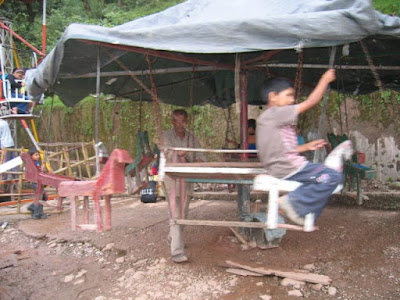
Indeed, from no where there was a small Big Wheel, a Swinging Ship and even a rotating Carousel of Horses. The mechanics of the amusement rides where as simple as they were baffling. The Big Wheel was spun by a group of (once again) young and witty Indian men, who caught a box of people and swung it over to the next waiting pair of hands, and somehow the small Big Wheel keep rising to the sky, and then falling again. Across the muddy lane, the Swinging Ship was reaching heights causing one chubby uniformed school boy to cry out in horror. When a certain height had been reached,(or maybe when the cries were deemed loud enough) a bored looking guy, seated under the boat peddled a peddle, which lifted a rubber tire, which touched the bottom of the Swinging Boat and slowed the waves of air which it appeared to be riding. As for the rotating Carousel of Horses: A worn and withered old man, topi on his head and cigarette dangling from his mouth, walked around and around and around and around, stepping over the wooden planks he had laid to solve the mud problem, and on his dizzy walk, he took with him the Carousel of Horses, on top of which sat young children, facings beaming, unaware of the toil exchanged for their smiles.


A Little Gentleman – who roams the streets, speaking perfect English, and looking like butter wouldn't melt in his mouth found us. He smiles and tells me that today he was bitten by a dog. We begin our usual exchange of silly conversation: “Did you bite the dog back?” I asked. “Yes, and then I ate him for lunch.” The Little Gentleman replied. “Ah so today you don't need food from me?” I say as I raise a doubting eyebrow. “No only ten rupees for the boat!” Between Bruno and I we find seven rupees. The bored looking boat peddle waves the Little Gentleman on anyway. He doesn't sit, but just stands at the back - next to the chubby crying boy. He smiles back at us, pointing to how high they are going. He couldn't look scared if he tried. The street hardened Little Gentleman.


Anyway, as I sit here listening to the rain splash against the blue plastic tent, and sip my hot glass of chai, I remember the point of recalling the crazy and colourful celebration of the end of the Monsoon. And the point is that somebody forgot to tell the Rains...

Wednesday, October 1, 2008

Baby Pillow

Today I heard a 'story' from a Tourist. The Tourist was upset. He had seen an Indian woman using what he thought was a dead baby for a pillow. The Tourist didn't want to look but he couldn't help but stare. The woman jumped up and grabbed the baby pillow by the legs. She approached him signaling for food with one hand while dangling the baby pillow by the other. The baby pillow wasn't dead – yet. The Tourist described the baby pillow as having bones for arms and eyes which were only half open: as if waiting to pass back into the oblivion from where it came.


The Tourist backed away and then walked as fast as he could away from the woman and her dangling, dying pillow of a baby.


What could the Tourist have done? What would you have done?