After a day in Kolkata I felt like I had been here for a month. After a month I now feel perfectly at home. 'Home' in the sense that I no longer feel like a stranger, that sights and smells are no longer new. 'Home' in that I see the same faces at the same time every day, and people no longer 'see' me quite so much. In fact for a 170cm tall blonde woman I feel relatively 'invisible'. Living in Kolkata is much easier than I had envisaged. People may be incredibly curious, but that is not because I am a foreigner. As the food program reminds me, curiosity is more part of Kolkata's 'culture' than anything to do with me. In regards to 'me' people are incredibly helpful. Traveling on my own is easier than most other places I have been. Although the streets are full with many more men than women, the majority are all incredibly polite. On all public buses and the Metro, instead of designated seating areas for the elderly or disabled, there are designated seating areas for 'Ladies Only'. In fact the Metro (which Kolkata is very proud of) is always quite a pleasant experience. Walking down the steps, buying a four rupee ticket, walking through the 'metal detector' door frame which beeps and flashes regardless of what passes under it, through the turn stiles, and onto the platform. Trains to South Kolkata (Tollygunge) on the first platform and to the North (Dum Dum) on the opposite side. A cool breeze flows through the station combining the underground air conditioning with the vacuum left by departing trains. Hindi music rings out as (usually) the latest Kolkata Knights cricket match is played on one of the TV screens. There are a scattering of sari clad women and then the spacious gaps are filled by shirt wearing men, standing in backless polished shoes (but "no shoe shines in the Metro"- please...) and synthetic lap top cases. A train arrives, rattttling along the tracks. And then rush. Everyone converges towards the opening sliding doors and piles in. Hot bodies pressing forward. Arms reaching towards the stainless steel bars. We women squeeze towards our 'relief' – the middle section of every carriage is 'our' space. I usually stand although some times one woman will insist on becoming my personal traffic warden, using her native authority to shuffle up all the other women to reveal a small gap for me to squeeze into. Otherwise I hold onto the cool railings and look, and my looks are reciprocated.
My own curiosity is reserved only for women and children. Although I feel completely at ease wandering around Kolkata, I also know that staring with a strange face to a strange face is not always the most sensible option. But in the confines of the 'Ladies Only' we all observe the 'strangers'. I am self conscious of my comparatively scruffy appearance: my straw hair loosely tied back and wrapped up this way and any way, with strands escaping creating a fuzzy hairy aura around me. Meanwhile I look at the rows of scrapped back silky black plaits or neat low ponytails hanging obediently down backs. Lines of red marking the parting of the married women's hair line, reflecting the third eye de-marked by red, black or jeweled bindis. My earrings mis matching, my necklaces made of string, my clumpy dive computer and my beaded bracelet look awkward and childish next to the gold droplets handing off every ear lobe, detailed delicate chains, and wrists full of jinglingly jangling colours. My kuta faded from its nightly washes, and still with the faint line left by the wire it was dried upon. Marks of sweat where my cotton bag is pressing against my body. I look at the seats full of colours. Of fresh cotton saris, some studded with gems, all bright and each telling their own story. Meters of printed material wrapping around and over and flowing graciously to the floor, to reveal polished nails sitting daintily in strapped heeled sandals. I hitch up my fishermans trousers from under my kuta, readjusting the two lengths of material which hold it approximately around my waist. I look down at my dirty feet, at my black rubber Flip Flops.
A recording is playing following our journey. Familiar words can just be made out from underneath the rattle of the train: Maidan left side, Rabindra Sadan left side, Netaji Bose left side, J S Park street right side. As I hear my exit I move to the door, towards the men. A space is made for me and as the doors slide open I join the 'exchange' and hop out through through the bottle neck, into the opposing movement crushing into the confined. Back onto the cool platform and the rush is over and the pace is slow. Ticket in the machine, pressing my body against the turnstile, until it resists, releases and spits me out. Left following the sign to the 'Kalighat Temple'. Two small steps at a time up to the busy, dusty, beeping road and a first left.
"Rickshaw Madame?" A foot rickshaw driver smiles. "Rickshaw to the Metro?" He jokes. He sees me every day and tells me "walking walking everyday walking." And everyday I repeat his words back to him as I walk on, and he stands waiting to find someone to walk – or run. “Kalighat Temple This Way!” A distressed woman shouts to me. Waving me back with her entire arm. I continue along my chosen path. A few weeks ago and her advice would have confused me, but now I am walking with faith in my recently installed automatic pilot, and confident that my programmed legs will take me the right way. I walk the length of the quiet small road. Past a few parked taxis. Past the cart full of bamboo, the open door on the corner revealing a tiny room crammed full of leather bound books. Past the seated women with the fluffy black dog. The daily connection by our eyes, followed by two instant smiles. The miti shop, with a glass window full of round, square, diamond, white, brown, yellow sweets. All different, but all with a common taste. A faded painting on a wall advertising the 'World Cup 2006' next to red graffiti scrawls of the Communist Party India - Marxists (CPI-M) symbolised by the hammer, sickle and star.
Across the junction and past the men sitting on the pavement, all of whom are absorbed in a card game, neatly laid out on a sheet of newspaper. One hand resting on the pavement, the other holding the symbols, and one cradling a small clay pot. Weight shifting as he scoops its creamy sweet contents into his mouth with a small wooden slip of a spoon. I can almost feel the coldness of the clay in his hands. It is misti doi, a delicious desert “unique to Bengal”, tasting like a rich thick yogurt. A lull lull crescendos behind me and I step between two parked taxi's to let the barefeet of the rickshaw run past before I reclaim the concrete. I turn left straight onto the puga stall street, which also leads to the Kali Temple. I walk confidently, and can now see 'differences' between this street and the ones parallel and intersecting. It has taken many long diversions to reach this decisiveness, and I no longer have to wonder around looking for tell tale signs.
The street is busier, smellier and louder. Raised voices. Zooming. Little people, old people. The colourful women are squatting in their usual place. Its too early to stand. The women look bored. Some are more confident than others and have no hesitation to look into the faces of those who walk past them, holding the stares of the men and boys. I keep trying to figure out their position in the community; whether they are 'visible' to those who live here. To me, they just look at 'home', talking, buying food from the stalls, sitting eating. But as always I am apprehensive of drawing conclusions from these briefest of observations.
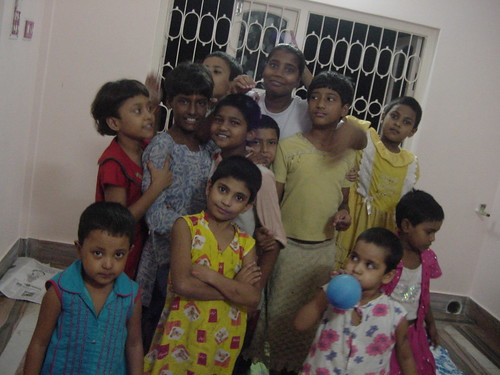
Two women are distractedly playing a board game with yellow and red counters. It reminds me of Connect Four, but its laying on the ground and the counters make no 'click click' sound when they are moved by the two hands of gleaming red nails. I take my sun glasses off and drop them in my bag to see what more 'connections' are there for me to take. I am very conscious of the glasses as they work to exclude much more than light. Sometimes a welcome barrier, other times reflecting an image not always wished to be reflected. A women who looks more Chinese than Indian, lips also gleaming red, is wearing a black sari made of delicate material and lined with tiny shining beads. She looks at my face and offers me one smile. I take it and as I walk past them into the stone alley way my eyes return to the muddy floor just in time to see her pedicured polished red toe nails. My eyes move back to my feet. Filthy. I squeeze past men in their lungi's and white vests, a small boy carrying a tray of glass chai cups. I dodge a muddy puddle and step into the courtyard guarded the body of an old man, curled up on the floor finding relief from the afternoon heat. Flip Flop Flip Flop Flip Flop up the small stone stairs. New Light. A blue colour pours down from the blue infusion created from the sun and the blue corrugated plastic roof. Fresh Air blows over the terrace and I walk into the Blue, fans spinning above my head, a line of children sleeping on wicker mats. I shake off my Flip Flops and leave them at the door. I walk into the class room, my eyes tracing those the sleeping children's head, the softness of which is broken by the one shaved one. Little Miss Squeaky Pineapple is fast asleep, wedged between two equally dream-a-tosed children. Today I will have a little more time before the 'EEEEEEEEEEEEEEEEEEEEEEE'. I wait.