Tuesday, July 8, 2008

Humanity


Another day and another reminder that despite two months of working with Gita that I still need to listen more. I don't hear the 'blank' in Humanity's voice when I ask how his day was. Or maybe I do hear it, but maybe I don't know how to give it meaning. Eventually Humanity finds the space to fill the blank. Eventually Humanity tells me of the third dead man he 'meets' in just over a week. His blankness is a silence which shows Humanity is still 'affected' and it is because he is still affected by the passing of the living to the body of the dead that he finds his day difficult. To me this shows that for Humanity death still has to be normalised and I am relieved, because I cannot really imagine what strength it must take to do his work every day.


Today Humanity found a group of street children jumping for biscuits. Then they jumped to the Dead Man – an old dead man, dirty and destitute and covered in flies. With flies flying out of his mouth and eating him from the inside out. With flies showing that he must have been laying on the platform for more than a day and for more than a night. With flies warning that the dead man was newly diseased from dying. And yet the dead 'flying' man was still surrounded by the life of the day. The porters laying by his side – sleeping or chatting or drinking chai. Of the street children pointing and then playing. Of the passengers walking around him because he smelt to much to walk over. Of the police who never came to move him, but who surely knew him.


Humanity was still trying to understand the attitudes of those around him. As for myself; all I can think of is that this is a city where the border between the dead and the living is too blurred. Where the fight for life is too widespread to spread to fight for the dignity of the dead. And I guess I am writing this because I want you to realise that for the destitute who live and who die here their suffering would be enough to kill 'us' within days. The destitute who walk with worms eating them; who live with diseases that should have killed them. That survive with disabilities so severe it seems impossible to live 'alone'. And they don't complain of pain because there is no point. They don't seek help because they don't think it will be given. They don't respect the dead because they die every day – in the streets where they live. And because as they are known as the living lower castes or the untouchables and even when they are alive they are not always familiar with what 'respect' should be. And there should be no them and no us but just a much much more humane way to Live.


Humanity protect your strength. Those who are still trying to live need it. You work to save lives - everyday. But please be careful. Everything can be taken.


Saturday, July 5, 2008

Minds 2 Open


I looked inside Gita's folder. One black and white line jumped out. It read “Birthday: 11thJune 2004”. I had missed it – in fact everyone had missed it, but I felt particularly guilty since I am the one person who after working with her every morning for two months should have known. Apparently she is now four years old. I am simultaneously surprised and relieved. Surprised because she looks too tall for a four year old Indian child and relieved because this means that her 'slow' development is not quite as slow as it would be if she were five or six. Her development has really made me start asking questions: she is the first blind person I have ever become close to and I have absolutely no idea if her behavior is 'normal'. Normally I would argue that 'normality' is a pointless reference. Everyone is different, and comparing a child practically born into an orphanage with one born 'outside' in what I think of as the 'open World' is already difficult. Throw into that mix a child born without eyes and finding out what should be 'normal' seems not so useful. However, this is a definition which neither Gita nor I can afford to ignore. Her future depends on her 'normality'.


Hare (my Krishna Christian friend) suggested that she might be autistic; which he said may be why she becomes so stressed at meal times and although we dad dad dd da da da d and ssssssssss shs sh ssssssss everyday maybe this is why her speech has yet to come? In my rational mind my explanation is firstly she is feed far to much food: surely hunger is a natural perquisite for wanting to eat? And secondly she is force fed what she cannot see or even touch. In regards to her speech – she has grown up surrounded by noise – there are 37 children in the nursery. Although the 'inactive' children in Gita's section are all mute apart from the occasional tears, the children from the 'active' section are in the same room screaming and shouting and generally just being 'children'. Then there are the foreign voices of the volunteers speaking in varying languages including English, Spanish, Japanese, Korean and French. Then there are the Bengali voices of the Mashis and then the English, Bengali, Hindi or Nepali words from the Sisters, all of which is against the backdrop of the sound system which definitely creates a happy atmosphere playing all variations of 'Hallelujah' to Hindi tunes (which Peter loves) to 'Men in Black' (which the Princesses seem to enjoy). Now just try to imagine yourself as a blind child: A four year old in the dark who is yet to distinguish words, let along languages. It must be like looking for the library and then ending up at a Rave – blindfolded. And yet when we reach the quiet of the roof Gita will quietly start to explore her own voice. Playing with no sense sounds, which to my trained ears I also need to explore – trying to give her new verbal replies which are not in my own blahhhing vocabulary. The Mashis also complain that she makes sounds all night – which again is the only time that the nursery is quiet.


However, if she is autistic there are several routes to explore: Firstly it seems most likely that autism would be a response to her environment: where she is picked up and placed down, or if she is moving she moves 'unseen' quietly finding her way around the room to be pushed or knocked over. Her environment where she grows from a baby to a toddler without knowing a mother. Her environment where she does not know love apart from that of the Indian workers whose job it is to feed her and wash her, or the volunteers who stay for a day or a month or like me love her and then will leave her, or the Sisters, who care but who have a Faith which totters on passivity leaving her development to kindness and prayer. Secondly if she is autistic then in the past two months she has made incredible progress, which suggests that she can improve – or even over come it? Already without knowing words she communicates with me: if she wants me to sit down she will pull on my kurta until she finds my shoulders and then push. If she wants me to pick her up she will push down on my arms so that I will lift her and swing her. And she recognises me. If I find her searching for the massive yoga balls squeezed between the beds and the wall and I call to her, she will start to crawl over the beds, once she finds my hand she feels for my dive computer and my rolling tat tat tat beads wrapped around my wrist. She explores her world with increasing confidence: climbing and touching – seeing with her hands and her feet.


After spending two months with her I also know that she is very aware of her surroundings. She can fit herself into her little table and chair (although her yogi legs will always remain on top of the table), she knows that there are two sets of ten steps to the roof and that the floor of the bathroom is slippery. To me: this is all amazing within the noisy hectic impersonal life of the orphanage's nursery.


Lately we have also been exploring outside of the nursery. After attaining the correct permission from the Sister in charge of Sishu Bhavan we have been going on an adventure to the park outside for the active and 'normal' children. The first challenge was finding her shoes which fitted from the communal pile. She surprised me as I was expecting her to kick them off, but she picked up her feet and let me put them on her. Down the stairs, through the stone corridor, past the active 'abled' children and then to the mud park. First stop was the gate which she clung to, playing with the 'ting' of the padlock on the handle. Next stop was a bush which brushed against her. Feeling the leaves in her hand and pushing them so that they would bounce back to her. We stepped over a small broken brick and she let me lead her to a swing. She felt the rusty chain with her fingers, flicking the rough surface. I held it steady for her and she pulled herself up. I placed my hands around hers on the chain and told her in a stern a voice as I could to 'hold on tight'. Then I began to push – she leaned back. Head facing to the sky, smile revealing all of her teeth, breeze pushing past her cheeks and then she began to feel the momentum. Her body began to lean forward and then backwards and before long I was not needed. She quietly swung herself – a silent weeeeeee wheeeeeeeeee weeeeeee wheeeeeeeeee weeeeeeeeee wheeeeeeeeee. And then she took her hands from the chain and placed them over her ears. Quickly my stern voice reappeared and somehow she understood. But I wonder what she must have felt – to be swinging free with her hands over her ears – blocking out all sound but just feeling the momentum? I feel so happy watching her pleasure but eventually I stop the swing. She takes my hands and lowers herself to the ground.


Next stop is a concrete slide. I show her the ladder. I tell her 'One Step' She amazes me by lifting one leg and finding the first rung. This must be so scary. A foot which can slip off. But she continues and while leaning back on my body lifts the second to join her first. 'Two Step' I tell her and very slowly the process is repeated. But this is as far as she dares to go as she is already the same height has me. She swings her body around and puts her hands around my neck. I realise that she is becoming much more affection with me than she used to me. She is accepting my presence. I pick her up and swing her. Again her hands go to her ears and her smile extends even further. I slow to let her feet touch the grass. I let go and she continues to bend down and feel the earth beneath her feet. She touches the mud and then brings her hand to her nose – a new smell. Seeing her 'meet' nature is powerful and I wish I could take her to the mountains – to feel real natural energy and not this urban construct. We walk over to a tap fixed on the wall. Already she hears the drip and starts to feel for it. Gita loves water. She finds it and I turn the tap to a trickle. She holds her hands under it and then begins to lower her head under it. I allow her a few seconds and wish we could just play in the water and the mud all morning, but as always I have accepted the restrictions to her freedoms. I try to image what it is she loves about the water – the coolness, the texture, the liquidity?


To me Gita is not 'normal'; she is amazing. And I tell her every day and when I do she smiles in unknowing agreement. She has such courage to explore her surroundings which are not 'blind' friendly but which are busy and noisy. She has responded by becoming the most independent four year old I have had the pleasure to meet – and perhaps this is why I admire her so much. Because she does not ask for attention but just explores her instinct – following sounds and feeling around her – blind to the affection of strangers or workers. Lately I have been thinking more and more about what will happen to her once she grows out of the nursery. The next step in the Mother Teresa Homes is to Daya Dan; for older children and then from there to the home for mentally disabled women (the majority of whom have been taken from the prisons by the Sisters). With this progression as motivation I have started hassling the Sister in charge of the nursery about Gita's future education. To me it seems that if she is able to develop the appropriate life skills there is no reason why she needs to spend her life institutionalised. The reply I was given was that unlike Jamie, Gita will not attend any specialised school for the blind – she is 'retarded'.

Friday, July 4, 2008

Perfect Babies


A sign on the wall reads "19 girls and 7 boys - total 26." A room full of tiny beds. Beds full of 26 babies. Some so tiny that they should not yet be in this world on their own. So tiny that their bodies still need to be made; with lips not yet closed and noses with no holes. They are so tiny that I dare not even stand too close. I don't want to bring them any of the diseases from the 'world' which they are not yet meant to be in. There are no incubators. There are no doctors. There is just “God's Will” which to my atheist logic means natural selection without the benefit of medical evolution. Others are more fortunate – they are in a limbo – not necessarily receiving the medical attention they need but in a clean bed with nutritious food; these are the babies whose destitute mothers have brought them to Shishu Bhavan in order to give them the strength which simply is not possible when you live on the streets. The mothers which I have met look much younger than me; they also look far far too thin for the new mothers which they are. But they come to visit their growing babies, holding them and hugging them, and sometimes taking them to Mass. Waiting until they are 'strong' enough to return to their homes on the streets or in the slums. Then there are the bigger babies. Babies that were born healthy but were born with imperfections. Imperfections that might cost the already poor parents too much. A trip to the hospital? Several trips to the hospital? Problems working? Trouble for their new baby girl to find a husband twenty years from now? Babies whose family decided that “survival of the fittest” was within their power to decide and who did not take their babies from the street but left them there.


I pick up a hand. It has fingers but the fingers are one. The toes the same – skin connecting skin. The little baby enjoys my touch and giggles like a baby giggles – noisily and bubbly. One small operation will 'save' her life and give her back to the world. I ask about her parents “she has none” I am told – at least none that want her. I walk past the 'healthy' babies – the 'lucky' ones. The ones who were just given away, or left on the street, or found by police men. The babies who are physically and mentally 'perfect' and therefore (unlike Gita) have more chance of growing up outside of this orphanage and most likely outside of India.


I stand over the cot of a baby who has little chance of living beyond this month. The baby is Screaming. Tears chase each other down her cheek. I start talking to her. Trying to soothe her. Trying to tell her she is not alone. Her body is tiny. Her legs only bone. No 'baby fat' for this 'baby' is a hydrocephalus baby. Her head is so enormous she looks like she has been invaded by a force far greater than her skull can deal with. Her head has incisions down the sides to try and let this force out – this force of liquid which has swollen her head to much larger than mine. I wish she could cry it all out. Her hand is wrapped in bandages with a key for an intravenous drip. The bandages weigh her hand down, fixing it to her cot. Her tears begin to slow. Her eyes are focused on a poster above the door. It is of three teddy bears. I keep talking. “Mummy bear, Daddy bear and Baby bear” I say. Perhaps she is not looking at the poster. Her dilated iris's even seem to have sunk to the bottom of her eyes. She seems to be staring right through me. I gingerly pick up the sheet she has kicked off and place it back over her tiny legs the length of my hand. “Those legs are too skinny to be naked” I tell her. She kicks them off again. “Bye bye beautiful” I whisper to her; beautiful because of the life which is within her, which is her, which after an incredible eight months she is still fighting for everyday - Life which I wish she could feel. And then; I leave her - to the bears and to her tears.


Thursday, July 3, 2008

Too Late


I talked excited about my day. About how brilliant Gita was. About how she made me smile, about how I couldn't help but follow her laugh, and as she laughs for most of the day I too laugh for most of the day. Really she gives me so much energy. I spoke about how we danced and shouted la la la tra tra la da da da daaaaaaaaa. About how on the count of One Two Three! I would run and Gita would lift her second hand to join her first and manage to trail behind me, smiling but scared and then laugh with relief and enjoyment. Most days I leave Shisa Bhavan so refreshed. As I was talking I was eating chocolate cake with hot fudge sauce and it was delicious. The sweet warm taste added a new form of energy to my body. I took tiny slices with the edge of a tea spoon trying to make it last as long as logically possible. Eventually I stopped to speak and I asked my friend how his day was. Eventually my friend stop saying it was find and eventually he spoke to me about how his day really was. Eventually I stopped moving my tea spoon, as I lost all sense of taste.


Eventually the image will fade of a young destitute man being kicked aside by passers by. The image of a young man who is in the way. A young man who is in the way because he cannot move. He cannot move because he lays dead, because he lays alone, with nothing but a shroud covering him. A shroud bought by my desperate friend, desperate to give him something too late. Desperate to share a love for humanity, a love for life, a love that the image of the young dead kicked destitute man seems never to have known.

Wednesday, July 2, 2008

Village of Rubbish


This week the schools have reopened, so it meant that the Nurse's other mobile clinic in Dhapa district has also re-opened. So off we went. Yellow brooming beeping taxi to Howrah train station, dodging past the foot rickshaws and walking piles of building bricks into a auto-rickshaw. Backpacks of medicines loaded onto the tiny backseat and then chugging through the traffic, far more refreshing with its nearly 360 degree air conditioning than the suffocating taxi. We arrive in a field of rubbish and unload the auto rickshaw. Gopal appears. The Nurse's loyal assistant who cycles around Kolkata preparing the clinics – and the patients. We walk over to a shell of a brick building - the community school. The team proudly tell me that they funded its completion. The school is quiet and once again communication was mis-interpreted and the school will re-open next week. But it is not a wasted trip as word will quickly spread about our arrival. The clinic is open air, although sheltered from the rain by an extension from the roof of the school. A red plastic table and chairs, the mirror of the ones at Tapsia Clinic, are waiting to be loaded with bowls of disinfectant and syringes. My job today is not to clean bones or remove parasites, but to wash little bodies!


The history of the village is unique and also founded on a potential health hazard, which is why the Nurse decided to base one of his projects here. Only five years ago the land which the village is built upon was a massive rubbish dump, filled with all the waste from Kolkata city. In a unique effort to reclaim the land the government literally created a mountain, by pushing the rubbish into huge towering piles, which from a distance appear to be made of rock and soil rather than refuse. The local people filter through the piles of waste to find anything which can be resold, reused or recycled. Glass is sold, cardboard is collected, plastic bottles gathered. And whatever is left is then ploughed back into the soil; a sort of rudimentary and very artificial fertiliser. Fields of refuse – soil which seems to grow medical waste, pieces of plastic and broken brown chai cups, which stands upon meters of archaeological rubbish from decades past. What is even more amazing is that fields of waste are Kolkata's main agricultural land. All of the fruit and vegetables which are sold in the markets, cooked in the restaurants and digested by my stomach are grown here. Apparently fruit and vegetables are have highly efficient waste filters; according to studies conducted by West Bengal Pollution Control Board (WBPCB), “no traces of metal have been found in the city’s ground water” and “the vegetables grown around the Dhapa dumping grounds have been found to be free of toxicity.” I still find it fascinating that the soil can handle such levels of rubbish; when I express my fears to leaders of the community I am told, “it's ok because the plastic does not biodegrade” - my concerns precisely.


A combination of concern and curiosity took me to recent reports from locally based environmental groups – and my findings are pretty alarming. According to the a study conducted by the Centre for Quality Management System (CQMS) at Jadavpur University as much as 2,600 tonne of solid waste is generated in the city every day which consists of non-biodegradable substances including plastic, electronic waste, batteries, metal cans, glass, paper, medicine foils and construction waste. Such substances do not degrade – with the plastic taking about 1000 years to break down which batteries will eventually break open releasing the carbon and adhesives into the soil. Now this is the same toxic waste which is being ploughed back into the fields around Dhapa. The CQMS argue that this not only destroys the soils fertility but toxic substances seep into the ground water, while the sheer quantity of the amount of toxic waste dumped is enough to contaminate the crops. The solution is for a system of waste segregation to be implemented. However, the Kolkata Municipal Corporation have no such immediate plans and if they did it would most probably consist of the creation of a second dumping ground at Dhapa. Another major concern is the disposal of medical waste. In 1998 the Biomedical Waste (Management and Handling) Rules made it mandatory for all health care units to set up treatment plants including either autoclaves or incinerators. However, only 12 city hospitals have waste disposal units and two have incinerators – this is out of a total of 649 units. Then in 2002 Kolkata opened its first commercial medical waste disposal unit in Howrah. Under the system, all healthcare units had to contract private operators to collect the daily waste in order for it to be incinerated. However, this has yet to be regulated, and according to the National Medical Journal of India biomedical waste is still finding its way to the dumping ground of the vegetable fields of Dhapa. However, the Nurse has more immediate concerns than the condition of the soil and contamination of Kolkata's vegetables.


The aim of the clinic is to gradually improve the health of the community as well as to provide basic hygiene education. Like Tapsia Clinic, the Nurse established the clinic in response to a need – there is no other health care facility in the area. Also like Tapsia, when he first opened the clinic, people were arriving with infections and illnesses which were fatal, whereas now he is mainly treating minor infections, thereby preventing their development into something much more serious. However, there is an additional challenge which the village faces and that is of the water supply. Compared to the centre of Kolkata, the village looks like a rural dream; spacious houses, green fields of manicured rubbish plots and surrounded by ponds. Take a closer look and it soon becomes clear that the ponds are stagnant with green sludge.


The run-off from the mountain of rubbish collects in the ponds, turning the water into filthy pools. People are washing pots, pans and their own bodies in a liquid which is green and balancing on top of a thick black silt. However, there are fresh water pumps throughout the village, so I asked whether these were restricted for drinking water only because of a limited supply? But this is not the case: people continue to wash in the ponds because they always have. The ponds are convenient – you just have to jump in, and there is no hard work in pumping the water. So this is why I spent the day washing little people under the fresh water pumps. The weekly wash is not just to clean some mucky faces but to initiate a change in behavior, encouraging people to wash with fresh clean water rather than the green pond 'water'.


A group of small children arrived to greet us at the clinic. The tiniest ones viewed us with a suspicion which was dispelled as soon as the older diddy grabbed my hand and grinned a “Nameste Uncle” to 'Uncle' Gopal. Our little tour leaders guided us down to the main village pump and washing began – shampoo, boxes of soap and bottles of Nivea moisturizer were lined up alongside the water pump. Uncle Gopal and I take it in terms to jump on the pump, filling up our small collection of tin containers and buckets. Soon we have a small group of helpers. Tiny children who expertly assist us by running and jumping, landing on the handel of the water pump and then swinging from it, sending streams of frothy cold water into the waiting buckets. The children are laughing but restrained by shyness. They want to be washed, but wait for us to motion then forwards, some accompanied by older siblings. The tiniest have no apprehension to strip off, leaving a pile of dirty shirts and pants in the mud, but the older ones (who are still tiny) are already mimicking their mother's modesty, and insist on being washed still partially clothed. We empty buckets of gushing water over little heads, creating temporary waterfalls and tense bodies which relax into toothy smiles and the production line of washing children begins.


A drop of shampoo rubbed into hair and followed by the lathering of pink bars of soap against black coloured brown skin. A scrubbing pad and the black is quickly removed, another bucket/ waterfall later and the washing process is nearly complete. I grab one of the three towels. A length of brightly coloured cotton which is wrapped around expectant bodies. Arms strapped close to chests and dripping faces smiling up at me, unsure of what will happen next. The towel absorbs the excess water as I rub little arms and legs. Occasionally Uncle Gopal will chastise me for missing some soapy patches and throws some water at the offending parts, creating confusion from the child in question, who thought the 'washing' process had finished.


The more I work with Gopal the more I realise the degree of his dedication. Younger than me but with the wisdom of a person twice his age: taking peoples concerns seriously, communicating with the young and old with equal sincerity, and totally committed to the projects – whether it be the food program at Tapsia village (Gopal runs a parallel program to the one I work on at Sealdah train station), dressing people's wounds or washing little heads. While we work he discusses his frustrations with his country. He speaks passionately as a dalet who has converted to Islam in an attempt to escape the racism of the caste system. Gopal blamed 'corruption', 'consumerism' and what he termed the 'Indian mentality' for the ever increasing poverty gap. I am still building the confidence to share my own views. Ever aware of my position as an 'outsider' as someone who remains outside of the caste system, outside of the gender divide, outside of the poverty trap and outside of the violence of community politics.


I motion for the little body in front of me to hold out his hands. He quickly opens out his palms expectantly. I shake the bottle of moisturizer and tip is upside down, squirting out a small squiggle of white cream. He looks up waiting for more guidance. I motion for him to rub his palms together and then spread on his body. He splats the cream over his palms and then gingerly dabs white spots over his arms. I smile inside and out as I give him some more hands on instruction by rubbing the cream firmly over his arms. He continues the process on this tummy, and I shake out a few more drops to paint on his face. I comb his hair, aware that I am definitely not up to date on the latest local Bengali hair style.


A father walks by holding a tiny tot in his arms. The baby is wearing kohl around his brown eyes and a faded floppy yellow hat. The father turns his body so that his son can observe the washing process. I look up and smile. The baby looks down and cries. Other little children are queueing to be dried, combed and moisturized, with bigger sisters loitering nearby hoping to garner some excess cream from the little ones palms.


Two hours later and our washing session has finished. Gopal spreads the three towels in the sun to dry and we pack up our small but coveted collection of cleaning potions. “Aunty Aunty one photo!” A group of young girls return, looking fresh, shiny and full of smiles. I accept their demands, showing the photos and creating a cycle of “one more – one more!” as I take different combinations of girls with babies and brothers and sisters and mothers, all wanting to see. I make various promises, which I must remember to honour, of printing copies and distributing to their 'owners'. We walk back to the clinic, hands full of smaller hands. I pass an open door to see my last little customer. The little boy who had such fun exploring the softness of Nivea Moisturizing Cream. He was sitting on the mud steps inside his house, mirror on his knee and a look of intense concentration on this face. It is an image that really showed me how special we had made some of these little people feel. Making them feel pampered and extra freshly clean, and hoping that the feeling will be so good that it will be addictive.


We join the Nurse who has packed up his clinic and walk down what can only be described as a country lane while Gopal pushes his bike. The lane is surrounded is covered in straw making a soft padding for our feet. The padding is actually 'mustard seeds' laid down in the morning to be crushed by travelers in the day and then collected in the evening. We find a cycle rickshaw and load the backpacks onto its cart, but we need to wait for more customers before we leave. So we sit on the cart and wait. Gopal is teasing one of the assistant nurses for looking like a “Bengali Woman” - the assistant nurse has opened an umbrella to provide protection from the sun – the assistant nurse is also a man, and this is a practice reserved mainly for women. I watch Bengali women working at the side of the road. They are lifting bricks onto a roll of cloth placed on their heads and walking/ jumping the tower of bricks to the other side of the road. Their is one male in their group – a serious young boy, bending and lifting and carrying and depositing.


The cart is full and we are ready to leave. Gopal protectively tells me to move my legs around to the back to avoid overtaking cars, and he cycles slowly behind us until the first junction. The journey is quiet. Just the momentum of the rickshaw, interspersed by the sound of its wooden wheels lifting and falling over inconsistencies in the road. As we leave the rural landscape of the fields of rubbish we approach the newly constructed residential complexs: A bubble of new apartment blocks, surrounded by fences, security guards and cameras. The inhabitants of which will never set foot in the nearby Village of Rubbish, and whose closest contact with the local markets will be via their servants. I already know that I have experienced far more of Kolkata's slums than many of the Bharmin I have met here, who listen to my daily accounts of poverty and destitution with surprise. It is reminiscent of my conversations with Israeli's from Tel Aviv when I would talk about life in the Occupied Palestinian Territories. And yet my conversation by the water pump with Gopal told me that my view of reality is still too optimistic. Gopal told me that his mother is a domestic help and her monthly salary is 1500 rupees (22 Euros, 18 GB pounds, US $35) He told me that he knows of many people who will work a full day of 12 hours for 50 rupees (0.74 Euros, 0.58 pounds, US$1.17) In this scale a bottle of Nivea Moisturizer is the equivalent of two days work, and a Barrista Coffee far too much for me to ever again drink guilt-free.


Gopal cycles back to his village and our rickshaw joins the main road. A truck crusades towards me, beeping and braking just in front of my legs before swerving to overtake. The man in the passenger seat grins at me out of his wound down window.


For more information of the Village of Rubbish and Kolkata's Waste Disposal see the following:

“Master Plan on Solid Waste Management” Kolkata Municipal Corporation

"News from Here and There”, National Medical Journal of India

“Promoting Sustainable Consumption in Asian Cities”

Pollution Potential of Leachate from East Kolkata Solid Waste Dumpsite

West Bengal Pollution Control Board

Sunday, June 29, 2008

Little Wise Babu


Little babu has the face of an old man. He looks wise. He totters around – the youngest little tot. Two years in this world. Yet he knows the score. He is as wise as he looks. He searches for Aunty. He slowly approaches her office and pokes his head around the bottom of the door frame. His eyes find her body laying on the floor. She is sleeping and he is wide awake – safe on his mission. Little babu bends down towards the floor, hands out stretched he lets his weight topple him forwards. His palms save his head and he is now in a position to crawl. Little babu crawls under the desk and his little fingers find what he is looking for. He presses the switch, looks around and then retreats. He pushes himself up and continues turning off the power. Little Conservationist. He recognises me – but I am only a familiar face. He waits for my reaction. I smile and he smiles back. He is safe. He is mischievous. He decides to put some distance between us. He totters between the racing children. Zooooom they whiz around him.

Another pair of eyes reach his line of sight. Another babu. Like a magnetic connection they are pulled together. Tottering they join forces in this whirlwind of energy. United they manoeuvre like two little unsteady robots, negotiating their way between the racing legs and the unseeing teachers. Focusing on a destination and tottering their way there– hands united. Their tininess makes them invisible as I watch them become babies again to those who see them. Little wise babu reaches for a steel cup of cold water. He wraps his little hands around it and drinks. He is collected by an older child, passively lifted and then deposited. His head turns slowly around to find his abandoned friend and once connected his body joins his eyes. They move further away from the noise and they stand together in the courtyard – watching. They look like two wise old men – watching over the youngsters, discussing the past and the future. Then something catches his attention. Little babu wanders over to the edge of the courtyard, holds onto the red bars and peers down. Quack Quack! It is the muddy family of muddy ducks. He watches the little ducks patter about obdientently following the mother duck. Quack Quack! He is silent - staring - and then lifts his head and see me - staring - out of my open barred window. He turns around. Tottering.

Little babu begins to scream. He was tripped up by a passing whirlwind and has fallen over on the concrete. His little friends is distressed and trying to help. A little pineapple girl hears the calls and her six years mother the Little babu. She picks him up and takes him by the hand. As always she is smiling as she leads the little babu with the wise old face to someone who will soothe his tears. His lip is cut and is bleeding, but all he really needs is reassurance that soon one day the world will stop pushing him over and he will be able to stand his ground. Little squeaky pineapple girl finds An Adult. The day is saved. She returns to the role of child in this space where children can just be. Little babu is quickly quietened. He is curious again. Searching around him, looking in control and ready to move on. Little wise babu. Two years in this world. Born into this beautiful world with blood that keeps trying to kill you.

Saturday, June 28, 2008

Bbbbbbb beautiful Ssssss sounds


Today we are sitting on the floor. We are waiting for lunch. All the other children are strapped into their chairs, each individually being fed. Apart from Ana who is on the floor, curled up, eye lids tightly shut. I am entertaining Gita by banging on the table. “Boom Boom” I sing to her “Boom Ba Ba Ba.” The Tap Tap Thud of our hands on the plastic. Da dad da dra-ra-ra da da. Da Da da-da-d-d DA! Da dad da dra-ra-ra da da. Da Da da-da-d-d DA! I sing to her. Ba ba ba ba ba. AAAAAaaaaah. She replies. I feel a release inside me. A new energy coming from her. Da dad da dra-ra-ra da da. Da Da da-da-d-d DA! Da dad da dra-ra-ra da da. Da Da da-da-d-d DA! I repeat as I Tap and Thud. She has removed her hands from mine and is stroking her face, moving her lips and her Baaaaaaaaaa turns to Brrrrrrrrrrrrrrrrrrrrr. I open my mouth and put my hand over it “AhAhAhAhAh.” She lets me open her palm and place it over her own mouth soon she is also softly producing AhAhAhAhs. And she continues to Br and Ba and Ah. I am laughing through my efforts of encouragement; Ahhhhhhh Baaaaa, Da dad da dra-ra-ra da da. Da Da da-da-d-d DA! Da dad da dra-ra-ra da da. Da Da da-da-d-d DA! She starts to join my laughing. I start to tickle her and shake her so that her laugher vibrates through her own body. She keeps laughing to hear it continue. I pull her onto my lap, her legs outstretched on top of mine, but only reaching my knees. I open my legs and she falls through to the floor. Laughing so contagiously that even a smile breaks over the face of Little Princess Josephine, who rarely does anything but cry. I pull my feet together and she reaches forward for my anklet, feeling the rounded beads and then pulling her own feet together in a mirror image which she cannot see but only feel. I push her forward with my body - “Brrooooooooooooooooom” I growl, and then swing her to the right and backwards and then forwards, with sounds and shouts and taps and bangs and vibrations and laughter sending ripples of smiles around the watching faces of the other children. Brooooooooooooooooooooooooooooooooom and then screeeach back again. She is laughing.


I am handed a bib and a bowl of mush. I sing Indiana Jones to her (I saw it at the cinema last night) in between tap tap ta ta tap on her table. Her hands reach down to press on mine and I am able to wrap the bib around her neck before she has a chance to object. Next comes the hard part. “Gita Gita!” I begin. I scoop up a tea spoon of mush and while holding her neck slightly back with one hand shake off the contents into her open mouth. Immediately she begins to shake her head. Side-to-Side-to- Side-to-Side. “Gita Gita!” I sing to her. “Gita Gita! I Love You!” I keep singing, letting her know I am there, mixing English words with No-Sense words, which to Gita's Bengali ears and eyes that are filled with darkness, the meaning has little relevance, its only the rhythm which matters. Da Da da-da-d-d DA! My syllables getting louder and louder as the spoon arrives at her lips faster and faster. Her hands are still shaking and head still moving, but she still has an open mouth and the food is still disappearing. “Na Na Na”. She says to me. “Gita Gita I Love You!” I sing back to her. “Na na-n-n-na” she says before I manage to deposit the next load of mush. She does well today. She finishes her lunch and there is only one time were her movements quicker than my reactions as her little arm ended up in her bowl.


I pass her a cup of water. She competently holds it to her lips and tips back the cup. If only she could eat so confidently. “Brrrrrrrr.” She tells me. I realise she is blowing bubbles into the remainder of her water. As always we fight for re-possession of the empty cup. I wash her face with a damp cloth and then pull her up “One Two Three.” Her legs follow the demands which I made of her arms. We walk over to her cot and I begin another small routine which I have replaced from the usual 'lifting and depositing' of 'dis-abled' children. I pull down the bars and place her hands on the bed. Next I reach down and place both of her feet on the bottom bar of the cot so that she is now about 10cm from the ground. I lift up her knee and place it on her mattress. As if on auto-pilot she grabs the mattress and pulls herself up into her bed.


Trrrrrrrrrrrrrrrrrrrrrrrrrrrrrrrring! The bell rings. “Auntie Auntie” a mashi quickly motions for me to leave. I whisper a Good Bye to Gita. I turn away – I turn back. Gita is sitting facing me. Hand brushing over her lips “brrrrrrrrrrrrrrrr” I am not sure if she has yet sensed my distance. I Wave another Good Bye. I smile. A stupid wave. I walk away, hands by my side, ears wide open.


There is a new sound which Gita helped me to find today. It was a sound which I heard for the very first time; it was the sound of Gita's Voice.

Friday, June 27, 2008

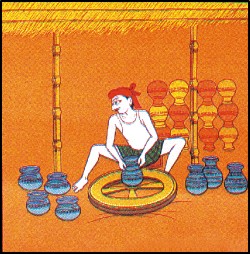
The Potter


Tonight there is a very weird light. The sky has turned orange – the colour of gold. The buildings in the distance appear as if they are houses filled with sun. The air in the stone room is still and full. I walk to find freshness, away from the spun golden sky, through the room of colours and smiles and out onto the balcony at the back of New Light. Facing away from the setting sun the sky is already dust coloured. My eyes take a little time to readjust from the strip lights of the classroom and gradually I see that the reflections from the glowing clouds on the still river creates a false silver light which is fading quickly. The air seems a little fresher as it touches my face, enters my nose, refreshes my lungs. I haven't stood here before. I could easily forget I am in the centre of Kalighat. The river, the quiet, the stillness. But then my eyes readjust some more. Small figures dance around just below me. They stop. All is quiet. Then muffled laugher. Movement. Stillness, and so it continues as the children are playing a game of tag, where every time 'It' turns around they need to freeze in time. The fresh air begins to smell of burnt perfume, and I look down to search out the source – a white pillar dirty with the days, housing a Hindu deity and coloured with dying garlands of orange flowers, is sending up signals of smoke. A strange movement catches my attention. I move my eyes to the one small building sitting at the edge of the river. It has a small roof, corner pillars made of wood and no walls.

There is a man wearing a blue checkered lungi and a white sleeveless vest sitting on a small stool. He is squatting in front of a shape which is changing, transforming in front of his hands and in front my searching eyes. The man is manipulating and expertly moving a mound of clay. He is making it grow taller and thinner. He is removing sections from the top, and setting them down on a tray by his side. I focus my eyes and gradually I begin to discern rows of tiny clay cups. His fingers return to the spinning block in front of his bent knees. Spinning, rising, falling, removing, replacing. The mound of clay seems infinite as he is able to make it grow to the same size despite continuously creating and removing small pots. Gradually the lump of spinning clay can no longer keep up with his manipulations and the original lump is almost completely transformed into rows of stationary chai cups sitting wet at his feet. The wheel stops to spin. The original lump disceted and recreated, leaving a small stationary mound. The potter reaches across to push the new pots away from him, pulling forward a empty tray waiting to be filled. He lifts up a block of untouched, virgin clay and drops it onto his wheel. He picks up a wooden stick and begins to spin. His arms transfering his energy to the edges of the horizontal wheel. The momentum building, his foot working and then he releases the stick, lays it back down by his right side and splashes water over the spinning revolving lump. Whirling with momentum the clay turns. His hands settle on the side of the lump and as if by magic the clay surges upwards. It becomes smoother, uniform, full of soft ridges. Thumbs inserted and another chai cup is created, dis-attached from the whirling lump and then laid down on the new tray. And so it continues. Mesmorising me.

Eventually my eyes can no longer adjust to the fading light and it becomes harder to follow his work. But I am left feeling calmer. The evening air is cooler. I feel a two small arms around my legs and I look down to find a Little Miss Squeeky Pineapple. I reach down and pick her up and walk back into the blue light of New Light.

Thursday, June 26, 2008

The Young Ladies from the Soma Home


Urmi draws me a map. It is full of squiggles and no real reference points. I am so going to get lost. I tell her my fears and she dismisses them, telling me it is easy and if I become confused to phone one of the many mobile numbers she writes down for me. I take her squiggles and apprehensively fold it into quarters and put it in my kuta pocket. I am going to try and find Soma Girls Memorial Home. The Soma home was founded a few years ago and it is for the girls of New Light who are older or more at risk. What I mean by 'at risk' is fairly subjective but basically means they are at an age where they are more 'at risk' from attracting the attention of their mothers' clients if they stayed at the main center in Kalighat. Or it could also mean that their families are on the poverty line and they are therefore more at risk from being sold or abused. The other girls who live at the Soma Home are those who have already been abused and have now been rescued. As the girls are aged between six and eighteen there is clearly no minimum age of abuse, and the threshold between 'child' (abuse) and 'adult' (consent) remains appropriately vague.


The Soma Home was named such in memory of one of the girls who died an untimely death due to the absence of proper medical care. The Soma Home is situated in the South of Kolkata, near an area called Tollygunge which is known as the more 'upmarket' part of town. One metro ride later, followed by one autorickshaw and a ten minute walk through a uniquely suburban area and I have arrived at a wide paved avenue. The avenue is lined with trees and the foot rickshaws have been upgraded with cycles. Urmi's squiggles have miraculously done the job and I am left facing a large peach coloured building and a varnished black gate. I ring the bell and a women emmerges. Her English matches my Bengali which means that it is only through a combination of hand signals and smiles that we are able to communicate. I am let into the Home and follow the noise of girls voices up the staircase. Immediately I am impressed by the decor. Seriously nice! Pastel colours mixed by inset Hindu shrines. The House Mother greets me. An older Bengali women, who politely smiles but who lets the girls do the entertaining. There are another three women there. Two young teachers, who are fashinably dressed, speak fantastic English and clearly part of Urmi's plan to provide suitable role models for the girls. They later tell me that they love working at the Soma Home and often come during their time off just to socialise with the girls. There is also another lady with the girls – one who has a remarkable presence. I later find out that she is a social worker. It soon becomes clear that New Light is doing everything in its power to prevent the girl's past from inhibiting their future.


The Soma Home has a powerful effect on me. For those of you who don't know – between the ages of eight and seventeen I lived in an insitution. It was a socially acceptable institution. Not an orphanage in the traditional sense, as it included children with parents, just those who for a variety of reason, decided that it was preferable for their children to grow up away from home. My school was the first and the last all girls boadring school in Scotland, and at the time extremely strict. I remember the early years as being particulaly 'cold.' The dorms were big, filled with beds, limited space for personal belongings and with no carpets underfoot or unncessary decorations. Food was controlled, freedom outside of the school grounds forbidden, every hour accounted for, living space shared with girls from a range of ages, and holidays during term time limited to one weekend once a month. I remember my first day, walking down the central staircase holding on to my mothers hand and looking at the approaching door, knowing that very soon I would be forced to let go and watch her disappear back into the outside world. The feeling of dread building up in me until I could no longer control it and tears spilling out of my young eyes. And then very soon, I became hardened to the routine. At the age of ten I would chastice the 'new' girls who still cried. By seventeen I was so 'independent' my father was confused about how to exercise the parental control he has unwittenly released nine years before. In contrast the girls at Soma Home seemed genuninely happy. The environment was relaxed and very comfortable and 'warm'. We laughed so much. The relations between the young and old girls seemed genuinely caring with many being sisters and the rest being freinds. What struck me the most was the confidence of the girls. They were polite and yet inquistive, and there was absolutely no sign of their background, but only a bursting of dreams to be realised. Girls told me of their boxing classes, Kathak dancing classes, English conversation classes and college applications. I asked if I could see some Kathak dancing and within minutes a space was cleared and five of the 'older' girls began with the opening prayer. The prayer was physical as well as verbal and the aim of which was to give thanks to their teacher, Guruji Pandit Chitresh Das who is a famous classical Indian dancer. Gurji teaches the girls whenever he is visiting from his Califonian home, but the girls continue to practice every day. The dancing is impressive, and with front row seats I sit there grinning as the girls coordinate their moves, stepping in time and speaking the impressive kathak chant which quickly pulls me into another world. The younger girls sit crossed legged next to me, necks bent backwards, eyes pointed up and whispering the sounds, clearly waiting to follow in their expert foot steps.


I am given a tour of the building by a group of girls who surround me like my own aura. Holding tightly onto my hands, and when one lets go another hand quickly moves to take its place. The dorm rooms each contain two bunk beds and a large wardrobe. I am shown the 'babies' bathroom with its tiny shower, knee high toilet and sink. I am shown the computer room, where the lights are turned off to reveal a ceiling full of glowing 'stars'. I am shown the beautifully decorated guest room, invited to jump on the bed, and then invited to stay. "Not tonight" I reply, but in reality I feel scared to stay. I am not sure what emotions and memories this place can evoke.


I leave happy, with shouts of "Good bye Aunty" chasing after me, and little hands refusing to let go and begging promises to return soon. "Turn left Aunty!" they shout through the veranda which they have all piled out onto. I retrace my steps, and smile at my lack of direction. I wave another goodbye and a Thank you. I will return. And next time I will bring some Magic to share with the Magic already shared...

Tuesday, June 24, 2008

Open Ears


Da dad da dra-ra-ra da da. Da Da da-da-d-d DA! Da dad da dra-ra-ra da da. Da Da da-da-d-d DA!


Exploring sounds. Walking around with my eyes closed. Trying to imagine never to have known sight. Trying to imagin the intensity of her other five sense; the power of touch, of textures, of temperature, of vibrations and of movement. Her strength of smell as she pulls my fingers towards her nose if I have washed my hands with soap and disinfectant before feeding her. Trying to imagine how intimidating it must be to have taste put into your mouth and how those tastes taste. Trying to imagine how to make sounds, how to talk, how to learn what 'things' are and 'who' people are when they remain invisibile. Trying to Listen. To hear my own voice. My own laugh. The whirl of life around me. Trying to imagine the courage which she has to explore this world.


Today, during her daily exercise regime, we explored the roof. Gita and the other children are brought up to the roof (for as long as the rain holds out) every evening for sunset. Usually she is left to play with the toys, ride a bike or is swung around, but always surrounded by action and activity. After successfully side-steping the mashis we began our daily exercise regime and began our Climb to the Sun again. We were rewarded by our determination by finding a 'quiet' roof, ready for us to explore.


With Gita's hand in mine I guided her over to the wall, and placed her other hand next to the hot brick. We walked around the outside, our bare feet - Pat pat Pat pat - on the hot and uneven concrete. I looked down onto the streets below. I don't need to lift Gita up to be able to 'see' as the muffled noises of the yellow taxis, the rickshaws, the fruit sellers rises up to us. Despite this it still seemed silent. Wind finding our faces. But the air still felt still. We walked under the lines of washing, the sheets brushing against our skin. I move her hand to hold the wire line. She moves it slowly backwards and forwards then faster and faster and faster. I kneel down to her level and listen very carefully. Ding Ding Ding Ding. Such an incredibly soft sound. Then her attention is moved. Her hand follows the line and she finds what she is looking for. A plastic clothes clip, spinning 360 degrees with the movement of the thin wire line. Rattle Rattle Rattle it spins. Rattle Rattle Ding Ding Rattle Rattle Ding.


Pat pat Pat pat. We walk slowly on. Her right palm reached out. Waiting. Two large plastic barrels. Turned upside down. Warmed Hot with the Heat from the sun. She strokes the side but then her hand remains still. Tap Tap Thud Thud Da Da Da d d d d. I randomly create different sounds from the outside to the edges. She doesn't tap herself but instead she moves her hand on top of mine and pushes. Faster and faster she makes me bang. Both of us listening. And then I stop. Silence.


Pat pat Pat pat. We walk on. A soft drip. Her hands feel around the top of a red bin filled up with water. I wait in anticipation. Her hands become wet. Without even a moments hesitation she leans forward. Arms right down, head following, legs trying to lift. I am smiling so much, but I pull her out. I want to let her jump in and splash and explore the Wet. But for now I unwillingly try to restrain her. I have to. We are meant to be downstairs in the 'nursery' and not exploring the amazing sounds of the mundane roof. I have already ignored the protests of one mashi, which was easy as it was in Bengali, and my replies of revolution in English. But I don't want to jeopardise any of our future morning adventures by bringing down a soaking (smiling) wet Gita. With a reluctance equal to Gita's determination, I hold her back. She pushes her body onto my arm and learns forward. Her arms submerged. I close my eyes and let her splashes touch my skin. It is warm, moist, refreshing, and very 'different'. The wind touches and combines to produce cool, stinging sensations. But Gita is still trying to climb into the bucket and the only way I have to stop her is to do what I know will always work. I tickle her and tickle her until she is laying on the floor with her contagious laugh, laughing so loudly that I am also laughing. Almost as if there was CCTV a mashi appears bringing with her what I can only imagine to be shouts of objection as she takes Gita from in front of me, lifts her up, and carries her down the stairs. I feel annoyed as I wanted Gita to practice walking down the stairs on her own. But really there is little I can do apart from follow. Pat Pat.


I am still smiling so much from Gita's laughter. It is still rippling through me.