Showing posts with label kalighat. Show all posts

Thursday, March 11, 2010

Songs from Kalighat


Two years ago this May I visited Nirmal Hriday. It was Mother Teresa's first of many homes, and known as her 'home for the dying and destitute' in Kalighat . What I remember of those first days as a volunteer was seeing a mirror for the first time of a reality which I could not handle. I saw the sheltered aspects of what I had arrogantly presumed to be a worldly life. The suffering of the patients; their pain paired with a defeat born from acting out their roles that came with their free cot, filled my mind with confusing justifications. I was forced to question what I was doing and why I could not do it. I lasted only a few days at Nirmal Hriday, and event though at the time I felt defeated and humbled, it was ultimately intelligence which made me leave. I left and moved to Sishu Bhavan where I uncovered another secret – a skill set which I had not realised that I possessed, and of course I met one of my most powerful life mentors - Deepa.

But thanks to Kolkata, in the past two years many gaps have been filled. My naivety has been dulled, and although important questions may not have been answered, at least they have been asked. And as life has a habit of doing, the very reason why I ever stopped in Kolkata is now working by my side.

Two years ago while I was living one of my many lives, my friend – an Angel diguised as a mermaid - and I were working under the sea with the ultra rich and a lifestyle which I had the privilege choosing. She told me about her previous work in Kolkata and told me to visit. It just so happened that the cheap flights from Bangkok to India were to Kolkata, and it just so happened that the first volunteer I spoke to once I arrived was a friend of the Angel's, who took me to register at the Missionaries of Charity. Now our paths have crossed again, and the Angel is volunteering at Nirmal Hriday and has asked my advice for how to work with the blind women confined to their beds. Using this as an opportunity to face a previous trauma I went back to revisit what I had once walked away from in nauseous tears.

Now I walked into Kalighat and saw a very different picture. I saw rows of women who had forcibly had their heads shaved. I saw rows of women who did have families, but for whatever reason were separated from them while no effort was being made to soothe that wound nor rectify that deep and raw separation. I no longer saw helpless victims or "bags of bones"; instead I saw very weak and sick ladies, sucked of energy by the asphyxiating atmosphere and devoid of options by a failing society. All of the volunteers, with the exception of the Angel, were drinking their afternoon chai on the roof, which even if the patients had the strength to climb the stairs, they are forbidden to. The Angel was beaming out her contagious energy; a natural nurse with an innate comforting presence. She led me through the rows of beds to a very old women who is living with cataracts. One of her eyes was totally glazed over with a thick milky layer, while the other was fighting the invading and unwelcome skin. She was almost totally blind. I introduced myself and she motioned for me to sit on remaining space left in her little cot. She was one of the ladies who astound me with their grasp of the English language, providing a key to a past lifetime away from their deserted and poverty driven reality. I asked her if she liked music, as I had come armed with my karimbu, but she was not interested in being entertained. Instead she quickly found out we had a favourite poet in common, and she began to recite songs by Rabindranath Tagore. She sang beautiful melodies in her native Bengali before translating them into English, moving her hand from side to side as she conducted her own renditions. Her voice was incredible, perfect, and her songs blacked out the rest of the ward, killing the discomfort and occasional moans of the women laying all around us.

The singing blind lady had actually studied at Santiniketan – Tagore's world renouwn school and unverisity. She recollected the concerts which her and her freinds would perform, allowing a smile to capture her face and take her back to a colourful happy time safe under the guard of her memory. I left her humming to herself as the Angel motioned me over to another cot, on which lay a much younger women – a women only twenty years old, but also living without sight.


The woman had been picked up at the station after being severely weak and malnourished. After a short stay in Kalighat she was much stronger and the Sister's are searching for somewhere else for her to go. The options are few – she can either return to live at Howrah train station, begging in her darkness, or perhaps the Sister's will move her to Shanti Dan.


Shanti Dan is one of the Missionaries of Charities homes for mentally disabled women. I have never visited, but I have heard several accounts of the ancient treatments used on the women. I know a volunteer nurse who was asked to leave after she began protesting about the use of electric shock treatment, including on epileptic patients. I stayed for only a few minutes by the side of the young women who I did not know. She lay still, with her legs curled into her chest under her uniform night dress. She remained rightly uninterested in my presence and besides all I could do was listen to the alarm bells ringing inside my head.


It will not be long before Deepa will be a young woman still under the care of the Missionaries of Charity. This is my motivation; for a different future for Deepa other than the one which is already laid out.

Wednesday, December 2, 2009

Fire


Twenty one years old and laying in a hospital bed, without skin. Charred black, and leaving ash on all she tries to hug. Naked but disguised by the lack of flesh. Ninety five percent burns and a funeral to attend some day this week – Doctors orders. I don't know her, I have only heard. What I heard is a common story, but the reality is that this is no 'tale' but the short life of one beautiful woman, born in Bangladesh and to die in Kolkata. Two nights ago she covered herself in three litres of petroleum. She threw a match on her body and burned herself to nearly dead. Her husband was arrested but later released. Her friends said he hit her – hard – but not on the face; that wouldn't be good for business.

Her story – her life - is Consuming.

As a young girl she arrived in Kolkata; pretty, tall and fair. Before long she was working the streets of Kalighat. Where the younger girls can earn more per ten minutes, then the older or darker women. The going rate is between 30 and 50 rupees per ten minutes (around 10 cents). At the age of sixteen she met her husband – a client. They decided to marry and move to his village away from the city. But soon her savings ran out, and she was expecting her only child. She ended up back in Kalighat, but this time working to support not just herself but her husband and new baby boy. Then two nights ago Fire must have seen like a solution to burn away her pain. Her little son trying to reach her, singeing his fingers. Her husband reeling in guilty tears.

But the fire wasn't as effective as it should have been. She is fully conscious. She can see – her body. She can move around in her filthy death bed. Crying out for water which she is not allowed to drink, and laying naked with only one bandage wrapping the IV drip to her wrist.

Just to reiterate. This isn't a story. This is reality. Now.

Saturday, January 3, 2009

Station Life


I am eager to find my colleagues from the Food Program at Sealdah train station, so at lunch time I head over to the canteen. The fat and jolly proprietor beams me a smile of recognition from this plastic chair of a throne, before shooing me away with quick and rapid hand movements: They have just left so I turn and race across the brooming booming roads, and merge into the mass of pavement traffic. Within minutes I find Deepa organising the team. She is standing with her hand on her hip, and bag of food parcels in the other hand as she shouts at Mohammed and her new assistant. I smile as I drape my arm over her shoulders. Surprised she grins at me before handing me a bag as if I had never left. Although communication is difficult, through a mix of sign language and broken English, she tells me that her recently adopted baby is very well. Her husband however, has contracted leprosy. Deepa herself appears as 'full power' as always as she marches through the crowds finding the participants of the food program.

We arrive at the train station. Sealdah station is quieter and although the rush of travellers ebbs and swells with the arrival and departure of each groaning train, there are far fewer station dwellers than a few months ago. The police are stepping up their 'clean up' campaign. Deepa does a good impression of their technique. She swings her arm rising it above her shoulders and then swinging the imaginary baton down to crush the imaginary destitute around her legs. It appears that the old women are hit until they leave, while the younger men have moved to a place where it is easy to run away if they see the 'security' approaching. Pugli has been moved into a temporary rehabilitation home after being found by Hope Charity. Hopefully she is still there and receiving help for her drug addiction. Meanwhile, the 'two brothers', Raju and Niraj, have regrown their full head of dreaded hair in time for the cold winter weather. They were squatting at the end of the platform, filthy and silent and still giving a high Namaste as we approached. Laura and Sarah, the two old women, have been forcibly moved on. On to where? I have no idea. The station has been their home for years. Smiling Harry is still sitting cross-legged in his torn lungi at the North Entrance. He still seems happy, and perhaps happier still as his Angry Wife appears to have disappeared.

In the absence of the women, there are been a few new recruits. I handed a package to one middle aged man, who replied 'Thank you' in an accent eerily English. Deepa raised her concern over an old woman laying at the entrance to the station. She had to be pulled up in order to sit, her tattered clothes revealing her hip bones and protruding ribs. She was laying at the edge of the car park and only meters away from speeding taxis and their dirty exhausts and spinning racing wheels. 'Kalighat', Deepa shouts to me; as if raising her voice will convey the urgency of her concerns. I have only just returned and have no idea if the Mother Teresa Home for the Dying and Destitute even has space for one more lady lying in limbo between this world and no world. But Deepa's stare and the dislocated gaze of the old bony woman stay with me. Later I speak to some of the Mother Teresa volunteers who work at the station, and the brief conversation results in the intake of the woman the following morning. It is one case among too many, but one which reminds me that we are not without power to act.

With one package left we walk around the car park looking for someone 'suitable' to give it to. The candidates are too numerous and it is a strange feeling knowing that you have the power to relieve hunger even if only momentarily. I leave the responsibility for deciding who should eat to Deepa. She marches across the road and shakes an old man sleeping on a concrete island. She asks him if he wants food, and he slowly pushes himself into a sitting position. I quickly take out the remaining box. But I am too quick and the cardboard too flimsy and it falls apart in my hands. Rice spills onto the road, and the small packets of daal tumble towards the feet of the old hungry man. My embarrassment boils inside me, travelling up my body and filling my face and then settles to a well in my eyes. Unable to look directly at the old hungry man, I apologise to the ground.

Sunday, June 29, 2008

Little Wise Babu


Little babu has the face of an old man. He looks wise. He totters around – the youngest little tot. Two years in this world. Yet he knows the score. He is as wise as he looks. He searches for Aunty. He slowly approaches her office and pokes his head around the bottom of the door frame. His eyes find her body laying on the floor. She is sleeping and he is wide awake – safe on his mission. Little babu bends down towards the floor, hands out stretched he lets his weight topple him forwards. His palms save his head and he is now in a position to crawl. Little babu crawls under the desk and his little fingers find what he is looking for. He presses the switch, looks around and then retreats. He pushes himself up and continues turning off the power. Little Conservationist. He recognises me – but I am only a familiar face. He waits for my reaction. I smile and he smiles back. He is safe. He is mischievous. He decides to put some distance between us. He totters between the racing children. Zooooom they whiz around him.

Another pair of eyes reach his line of sight. Another babu. Like a magnetic connection they are pulled together. Tottering they join forces in this whirlwind of energy. United they manoeuvre like two little unsteady robots, negotiating their way between the racing legs and the unseeing teachers. Focusing on a destination and tottering their way there– hands united. Their tininess makes them invisible as I watch them become babies again to those who see them. Little wise babu reaches for a steel cup of cold water. He wraps his little hands around it and drinks. He is collected by an older child, passively lifted and then deposited. His head turns slowly around to find his abandoned friend and once connected his body joins his eyes. They move further away from the noise and they stand together in the courtyard – watching. They look like two wise old men – watching over the youngsters, discussing the past and the future. Then something catches his attention. Little babu wanders over to the edge of the courtyard, holds onto the red bars and peers down. Quack Quack! It is the muddy family of muddy ducks. He watches the little ducks patter about obdientently following the mother duck. Quack Quack! He is silent - staring - and then lifts his head and see me - staring - out of my open barred window. He turns around. Tottering.

Little babu begins to scream. He was tripped up by a passing whirlwind and has fallen over on the concrete. His little friends is distressed and trying to help. A little pineapple girl hears the calls and her six years mother the Little babu. She picks him up and takes him by the hand. As always she is smiling as she leads the little babu with the wise old face to someone who will soothe his tears. His lip is cut and is bleeding, but all he really needs is reassurance that soon one day the world will stop pushing him over and he will be able to stand his ground. Little squeaky pineapple girl finds An Adult. The day is saved. She returns to the role of child in this space where children can just be. Little babu is quickly quietened. He is curious again. Searching around him, looking in control and ready to move on. Little wise babu. Two years in this world. Born into this beautiful world with blood that keeps trying to kill you.

Friday, June 27, 2008

The Potter


Tonight there is a very weird light. The sky has turned orange – the colour of gold. The buildings in the distance appear as if they are houses filled with sun. The air in the stone room is still and full. I walk to find freshness, away from the spun golden sky, through the room of colours and smiles and out onto the balcony at the back of New Light. Facing away from the setting sun the sky is already dust coloured. My eyes take a little time to readjust from the strip lights of the classroom and gradually I see that the reflections from the glowing clouds on the still river creates a false silver light which is fading quickly. The air seems a little fresher as it touches my face, enters my nose, refreshes my lungs. I haven't stood here before. I could easily forget I am in the centre of Kalighat. The river, the quiet, the stillness. But then my eyes readjust some more. Small figures dance around just below me. They stop. All is quiet. Then muffled laugher. Movement. Stillness, and so it continues as the children are playing a game of tag, where every time 'It' turns around they need to freeze in time. The fresh air begins to smell of burnt perfume, and I look down to search out the source – a white pillar dirty with the days, housing a Hindu deity and coloured with dying garlands of orange flowers, is sending up signals of smoke. A strange movement catches my attention. I move my eyes to the one small building sitting at the edge of the river. It has a small roof, corner pillars made of wood and no walls.

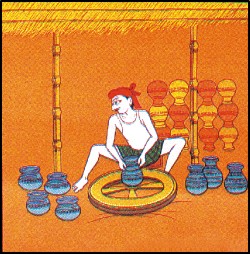
There is a man wearing a blue checkered lungi and a white sleeveless vest sitting on a small stool. He is squatting in front of a shape which is changing, transforming in front of his hands and in front my searching eyes. The man is manipulating and expertly moving a mound of clay. He is making it grow taller and thinner. He is removing sections from the top, and setting them down on a tray by his side. I focus my eyes and gradually I begin to discern rows of tiny clay cups. His fingers return to the spinning block in front of his bent knees. Spinning, rising, falling, removing, replacing. The mound of clay seems infinite as he is able to make it grow to the same size despite continuously creating and removing small pots. Gradually the lump of spinning clay can no longer keep up with his manipulations and the original lump is almost completely transformed into rows of stationary chai cups sitting wet at his feet. The wheel stops to spin. The original lump disceted and recreated, leaving a small stationary mound. The potter reaches across to push the new pots away from him, pulling forward a empty tray waiting to be filled. He lifts up a block of untouched, virgin clay and drops it onto his wheel. He picks up a wooden stick and begins to spin. His arms transfering his energy to the edges of the horizontal wheel. The momentum building, his foot working and then he releases the stick, lays it back down by his right side and splashes water over the spinning revolving lump. Whirling with momentum the clay turns. His hands settle on the side of the lump and as if by magic the clay surges upwards. It becomes smoother, uniform, full of soft ridges. Thumbs inserted and another chai cup is created, dis-attached from the whirling lump and then laid down on the new tray. And so it continues. Mesmorising me.

Eventually my eyes can no longer adjust to the fading light and it becomes harder to follow his work. But I am left feeling calmer. The evening air is cooler. I feel a two small arms around my legs and I look down to find a Little Miss Squeeky Pineapple. I reach down and pick her up and walk back into the blue light of New Light.

Saturday, June 21, 2008

Happiness


I search the running faces. I can't see the pineapple. I search the shaved heads. I look for the blue and white dress. There are several – but they are not her. I realise that I am disappointed. My heart sinks more than it already has today. She was the small happiness which I was selfishly searching. I begin to wonder where she is? Perhaps she just hasn't seen me? Perhaps she has forgotten me – maybe ten day is too long for a six year old trained to forget? Perhaps she has left New Light? But surely she would not have gone home unless her mother has returned from hospital? And what of the abuse she has already had to suffer once? The running feet whizz around me. I feel sad which makes me feel bad. I smile at the smiling faces staring up at me. Vying for my attention but I know the smiles I return are only shallow. Hands search for mine and small fingers play with my watch. Pressing the buttons but too weakly for any mechanical reaction. Their eyes remain focused. Loud little voices rise to me ears and I try to return the energy which they so freely give to me. Slowly I pull the fingers away and turn my back. The cries follow the disappointment I leave behind.


I lean on the balcony and search the running heads on the path below. I search for a small squeaky pineapple. But there I can't find one. Defeated I sit. A tray appears in front of me. It presents four small thick glasses of steaming chai; thick brown liquid wobbling beneath a shade of condensation. The woman who has made the chai and who is holding the tray does not use any words to communicate with me but only extends her arm. I reply by carefully extracting a glass, fingers wrapped painfully around the rim. She turns around and limps away, back into New Light. In my silence I sip the sweetened darkened milk. I stare onto the streets below. Children playing, women waiting, men joking. I feel guilty that two little girls have captured my attention – one without sight – one with too much history – both abandoned. I feel fortunate to have what I consider to be a real privilege to work with them. I know they give me far more happiness than the giggles which I can give them. But with one not here I am left missing. As I think these thoughts a “Eeeeeeeeeeeeeeeeeeeeeeeeee!” travels through the classroom! A Pat Pat Pat Pat Pat Pat at full speed! The smile accompanying our Crush is as large as the collision. I look down at the little shaved head clinging to my legs and bend down to greet the two eyes beneath it. We smile so much at each other. No words are exchanged as both know the miscomprehension which they will bring but the connection between our eyes and the happiness they communicate is much more effective than any “Hello! I have missed you!” I tickle her and she collapses even more as her arms wrap around my neck demanding to be lifted up and hugged. Huuuuuuuuuuuuuuuuuuuuuuuuuuuuuuug. So tightly. I kola walk her over to the swivel chair and point to her to remove the blue beaded bracelet around my wrist. Her small fingers quickly twist open the clasp and its rings fall away from my wrist. I wrap it around hers. One. Two. Three. Four. Five times it goes. Her smile is so wide that it travels around the room. She is torn between shouting for everyone to look and hiding it under our hands – just in case presents from Aunty are not allowed. She is playing it safe and as one of the tutors walks by the clever Little Miss Squeaky Pineapple folds forwards and presses her shaved head against my barbie hair. The tutor walks past and I tighten the clasp. I bring my right wrist next her hers. Snap! We match. Little and Large. Rings of blue beads around both of our wrists. She is smiling so much and it is a pleasure to see.


The bracelet had been for Gita as she always loves to feel the beads on my wrist and hear their invisible sounds as she rolls them against my skin. But as always she refused to hold her arms still for long enough for me to wrap it around her wrist and picked it up and threw it as far as she had the patience to. I feel happiness as unlike Gita, Little Miss Squeaky Pineapple shows me her smile. She lifts her head back and points it towards me and then sends her happiness and energy through her shining eyes. A bell rings and I begin the challenge of depositing her back in the class room. She has clearly become much more confident with the other children. She lets me place her down on the floor and she finds the little lady who had been so determined to work my watch. She shoves her newly decorated wrist in front of her and then grabs mine and pulls it towards her. Another pair of eyes search up to me. I don't have another to give I try to explain by showing my empty hands. The another pair of eyes doesn't understand. She wants one. I squeeze off the pink skinny bangle and pop it over her hand. It is so big for the another pair of eyes that it could reach all the way up to her shoulder. She is appeased but not satisfied. Little Miss Squeaky Pineapple sends a pair of hands up towards me. Arms outreached. Smile beaming. I mimic her as my hands reach up to the ceiling fan. She laughs and jumps. I bend and lift. We smile.

Sunday, June 1, 2008

Pineapple Girl


She is so adorable. How could anyone harm her? Six years old and already lived sexual abuse that I don't even have the strength to listen to. Six years old and full of so much light, that spills out of her as she smiles. And after spending her first day at New Light underneath the desk which I was writing on top of Little Miss Squeaky Pineapple seems to have grown quite an attachment to me. Now every day that I come into the center it doesn't take her long to find me. The pattern goes something like this...a little scream from behind, the pattering of running naked feet on top of the stone floor, and then ...Attack! A collision later and she has grabbed hold of me, jumps up if I am standing or simply hugs my waist so tightly if I am sitting. Today was no exception:


Eeeeeeeeeeeeeeeeeeeeeeeeee!” At which point I already turn around knowing what to expect.


Pat Pat Pat Pat Pat Pat as the feet come rushing towards me. Crush! Grab and Swing, as the swivel chair has to unexpectedly deal with a small tsunami.


And now we both sit here smiling. She has a shaved head today. Infected lumps of something, which meant that the hair had to go. She still looks beautiful. Short, Long or No Hair and Little Miss Squeaky Pineapple will still continue to shine and smile and giggle and laugh and want me to hug and hold her.

I will try and let her type:

hhhhmatmmadg

No she hasn't quite got the hang of it yet and her little hand just keeps resting on the mouse pad bringing up all sort of unwanted options. Now she just wants to touch the screen. Never mind, I will try and ask her to write to you some other time, however, its pretty hard considering that the little six year old can barely speak English – although she can smile SO much.


A little later and Little Miss Squeaky Pineapple has been collected and carted off by the teacher so many times I am beginning to think I should just save her the hassle and move into the classroom. We managed to have a small photo show before she was found the first time (after the failed typing experiment) and she went crazy, kicking her feet and jumping around on my knee, saying words to me which I have no idea what they mean, but which I repeated all the same between interjections of “Whale Shark! Manta Ray! Clown Fish (I won't say 'Nemo' as I am sure the film has no relevance what so ever for her) Lion Fish” as they flashed up before her amazed eyes. “Giant Moray Eel” – this one produced a reaction of even more kicks and squeals followed by a rather brave attempt to try and touch the screen. However, some quick thinking preemptive tickling and she was overcome by a fit of giggles. Next came some photos of me – hair down, bikini on, and my youngest scuba diver sitting at my side – eleven year old Akezjiah. Little Miss Squeaky Pineapple became extra excited at this photo. She touched my blue beaded bracelet on my wrist and then traced it on the screen, she pulled at my string necklace and then like a 'spot the difference game' tried to find my cowrie shell by peering down my kuta, only to find the silver charm from Mother Teresa via Mr Unconventional. She points to Akezjiah. “Ke?” She asks “Ke?” She points to the Me trapped in time and then returns to hit my face. She points to Akezjiah and then hits her own chest, little feet swinging and smile never ending. I reach over to click to the next photo and she pulls my arm back, she wants it around her and I am left trying to maneuver my left hand free from hers to show her move of this fantasy life under the sea but she stops me. She is fixated by the photo. Mesmorised. Staring deep inside. And then Slap! Two little hands on my cheeks followed by a Big Smiling Kiss.


The activity in the class room is growing more audible. As if reading my mind a stern voice shouts her name and she giggles into my kuta. Not wanting to betray her, but knowing our private movie showing of the Blue can't continue for much longer. I stand up. She holds on. Arms jump up to wrap around my neck and I walk like a clumsy overgrown kola into the class room. I try and put her down, but just like Gita she lifts up her feet in refusal. I turn around and sit her on a tactically placed bench. She climbs up and grins. I am left with the dilemma of how to break her fall but deposit her in class. Wheeeeeeeeeeeeee. And she Wins. I am back with a Little Miss Squeaky Pineapple hanging around my neck.

Monday, May 12, 2008

Kalighat

About 60 beds, all full of patients, stood closer than reaching proximity to one another. Light streamed in through the rows of open windows. Breakfast was in full swing. Volunteers seemed to go into automatic pilot and donned aprons before grabbing stainless steel trays of food. No instructions were given. No “Do's” or “Dont's” but just a whirlwind of activity. I managed to intercept a Sister to ask what I could do and was given the answer, which lay at bed number 40. The majority of the women at Kalighat were very old and with shaved heads, matching gowns and a massive language barrier meant that it was hard for them not to become a number. None have any family, and if it wasn't for The Mother house, would probably be lying on the street – or under it. Number 40 was no exception. She looked emancipated and incredibly frail. I picked up the plastic spoon and slowly she began to eat her now cold porridge. I found myself concerned that she wasn't ready for her next mouthful while my spoon hovered before her toothless mouth. We seemed to take far longer than all the other patients and volunteers and by the time she had finished, the plates had been washed and the beds stripped. I followed the stream of sheets through to the adjoining area with the men's ward, where a highly organised system of washing the laundry was under way. I joined a young Japanese girl and an older Spanish man who were fishing out sheets from a large stone sink with a bamboo stick and wringing them out. Neither could speak English. We wrung our way through so many sheets, pillowcases, aprons, rags and trousers that I finished the morning with red hands and happy biceps. For a complete workout I would just have to move down a notch on the washing conveyor belt; next to me jumped a volunteer wearing a T-shirt which read :

Americans brought electricity to my ass before they brought it to my house. Word on the Street, Baghdad.

The 'jumper' or rather 'runner' must have ran a mini marathon this morning as he stomped the clothes clean using a technique similar to that used to press grapes. He was Italian. A energetic energising Korean lady rushed through, peeling the wrappers of Cadbury's chocolate éclairs as she went. As if on automatic feeding pilot she popped a sweet in each of out mouths. “Amen” laughed a jumper. Behind the swashes of the water and the pounding of the feet came the raucous laughter and singing from the Indian helpers. “They sing all the day, that is until they decide its time to shout” smiled Baghdad T-shirt jumping man. It was essential balance needed to the painfully quiet lifeless living ward on the other side of the stone wall.


Back in the ward the ladies were either sleeping, lying or sitting. If I was able to catch their eye I took it as a opening in the gate between the expansive public space and their private bed and gestured if I could sit with them. I gave as many hand massages as I could. Rubbing joints that felt like stone and holding hands that I could hardly feel. One lady kept holding out her steel cup, repeating the word 'pani' as if it was her own private mantra. But no matter how many glasses she would sallow, her fever remained. She motioned to her head as if she were spinning. I massaged as gently but with as much focus as I could. And yes, if anything, in those few minutes perhaps I did something useful with my day.


A little bell rang – tring a ling – and the volunteers and Sisters filtered out of the ward and up the steps. We spiraled up and up, taking steps which would be impossible for the ladies below. Our journey finished standing in the warm breeze and gazing down onto Kalighat square, onto the streets where our patients once lived or slept. No one talked about the ward. We just sat or stood, and ate our chai with the help of large missionary wheat cracker, watching the daily life as if it were a soap opera performed to entertain rather than to live. It was the perfect place to observe and yet not to be observed. We were joined by a group of Swiss visitors with an Indian guide who asked where I was from. Scotland I replied. “Ah Scotland! Did you know that Calcutta was founded by a Scotsman? Mr Job Charnock in 1686!” I replied in my head, “or long before that when the land Kolkata stands upon was owned by the Bengali family Sabarna Ray Churdi.” Calcutta – Kolkata. Bengali – British - Indian. Such thoughts were not to be voiced. Not here. Not now. His foreign guests asked me why I volunteered. I replied that the Mother House was easy to access – it required no application, no interview, no 'volunteering fees' and no maximum time. They nodded and thanked me. I felt guilty for their thanks. Those to be praised sat behind me. Those who had been here for months and years, not hours. Their voices echoed down the stairs and faded into the horns and shouts of the street.


During my warm cold shower later that night I ran on top of my clothes, stamping out the dirt and the wringing them dry. It was much quicker than usual. The washing process was strangely therapeutic. I hung up my kuta on the washing line I had constructed from the shower pipe to the rusty hooks in the corner of my mini bathroom. I stepped into my mini bedroom to bathe in the breeze of the ceiling fan and took pleasure in being cool for the only time that day. The shower pipe banged to the floor behind me. Sleep was delayed with calculations of the large ceiling fan falling on top of me.